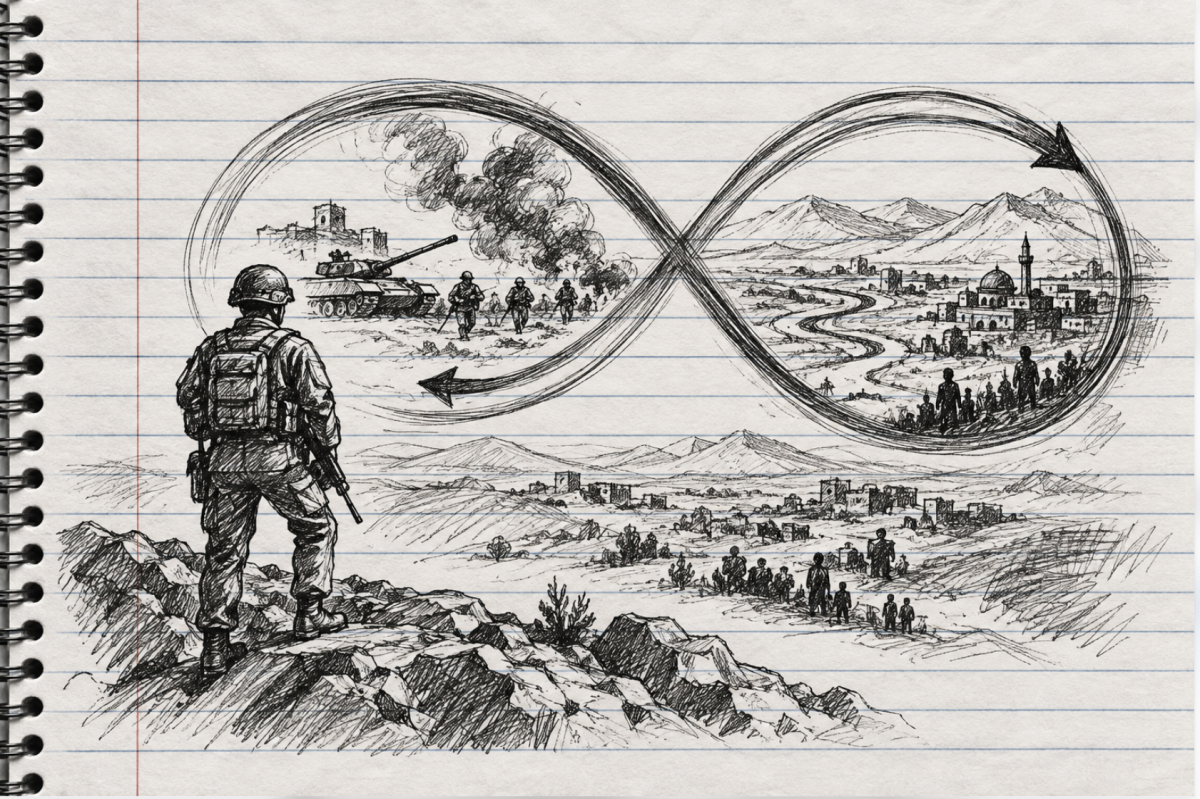
Why the United States keeps winning battles and losing wars, and what James Carse’s game theory reveals about its strategic mindset.
By Catherine R. Cline
America has a habit of winning its way into defeat. From the jungles of Vietnam to the mountains of Afghanistan, the United States has mastered the art of the finite victory: decisive battles, successful campaigns, and measurable wins that somehow collapse into loss. The problem is not military capability but mindset. As philosopher James Carse argued, finite players seek to win; infinite players seek to continue. America fights to end wars. Its adversaries fight to survive them.
Finite wars have bounded political aims, discrete military objectives, and recognizable endpoints. Victory is measurable: territory seized, regimes removed, networks dismantled. Infinite struggles, by contrast, are rooted in identity, legitimacy, or survival. Their objectives shift, their timelines span decades, and their logic prizes endurance over decisive victory. Strategic framing determines policy choices. Carse’s framework illuminates a recurring U.S. pattern: battlefield mastery inside strategic failure—finite wars nested within infinite struggles. This is not a case for endless war, but for aligning limited military action with political conditions that can survive withdrawal.
Carse’s Descriptive Language
James Carse’s 1986 book, Finite and Infinite Games, provides a powerful lens for analyzing conflict. Carse distinguishes between two fundamental approaches: finite and infinite games. Finite games involve mutually accepted rules and a clear beginning and end. They define objectives, scoring mechanisms, the playing field, and criteria for ranking winners and losers, all enforced within the contest.
Infinite games, by contrast, have fluid participation, shifting rules, and goals centered on continuing play rather than securing a final victory. Their timelines are unbounded. Adaptation, resilience, and endurance matter more than decisive victory, with strength, rather than power, as the central virtue. According to Carse, power exists only within finite play, emerging not as a static possession but as the capacity to overcome resistance within a closed field and fixed timeframe.
An infinite game cannot be constrained within a finite structure, but finite games can exist inside infinite ones. A finite win in infinite play is a transient moment within a continual contest. In Carse’s framework, participation in either type of game must be chosen; it cannot be coerced. That premise marks a limit to its application to war, where coercion is central. Applied as a strategic analogy, the contest becomes unbalanced when a finite actor confronts an opponent committed to continuation. The finite player seeks closure; the infinite player seeks continuation. Pushing for a decisive victory can prolong the struggle when military pressure fails to resolve its political foundations. The finite player may declare success, but the infinite player does not recognize the ending.
What appears to be final victories can therefore become unilateral declarations of closure, endings acknowledged only by one side. To the infinite player, these moments need not end participation; play continues without the departing actor. Strategic patience supports this approach, not merely accepting setbacks but actively building influence through incremental gains.
Strategic patience is not indefinite fighting. It is the coordinated use of diplomatic, informational, military, and economic power to shape conditions over time. Military victories are fleeting unless reinforced by legitimacy, economic ties, and sustained diplomacy. The challenge is not simply to win quickly, but to preserve the capacity to compete beyond the immediate victory.
This distinction matters. When actors define success differently, battlefield outcomes do not necessarily translate into political resolution. Infinite play describes a strategic logic that treats neither defeat nor victory as terminal to the larger contest. Participants may seek, achieve, or lose finite goals, but they continue to participate. What distinguishes infinite play is not patience or timeline length, but the refusal of imposed closure, the unwillingness to allow any single outcome to end the larger struggle. Yet Carse’s conceptual lens has limitations in real-world conflicts. Actors often employ hybrid logic, blending finite and infinite play or shifting between them as interests, contextual pressures, or internal divisions evolve. These dynamics complicate the application of an explicitly binary framework.
From Game Logic to Strategic Logic
Carse’s finite–infinite distinction does not equate to limited and unlimited war. It concerns how actors define success and closure, rather than the scale of their aims or military commitments. While Carse did not design his framework to map cleanly onto armed conflict, it provides a helpful analytical tool for examining those expectations. Finite framing assumes that achieving identifiable objectives will produce political closure: an ending both sides recognize and accept. Infinite struggles, by contrast, continue beyond individual campaigns and unfold across decades or generations. They center on questions of legitimacy, identity, or survival, making continued participation rather than any single battlefield victory the core condition of success. In such conflicts, the ability to persist preserves the opportunity to shape the political outcome.
The consequences of this mismatch become clearer in practice, illustrating how framing shapes policy. Afghanistan and Vietnam offer two examples of finite military objectives unfolding inside longer political struggles, where battlefield success did not necessarily produce strategic closure. The imbalance allowed adversaries to remain strategically viable even as the intervening power recorded measurable gains.
Case Study I: Afghanistan — A Finite Intervention Inside an Infinite Struggle
Afghanistan illustrates how a finite intervention can unravel when the opponent’s path to success depends on endurance rather than immediate resolution. The Soviet–Afghan War (1979–89) revealed a deeper problem than a clash of finite and infinite play. The Soviets entered with an immediate objective: remove Hafizullah Amin and install Babrak Karmal. They achieved that objective, but preserving a friendly and stable Afghan government remained unresolved—much as the United States later toppled Saddam Hussein without securing a durable political settlement in Iraq. Removing a leader did not settle the larger struggle over legitimacy, identity, and survival.
Once the Soviets achieved their immediate objective, they confronted an adversary capable of sustaining the struggle. The Mujahideen pursued political victory, but their ability to endure, outlast, and delegitimize an imposed government allowed them to continue despite battlefield losses. Soviet military power could seize territory and inflict casualties, but it could not generate the political legitimacy required for a durable exit.
U.S. support imposed costs on Moscow by stretching Soviet patience and international credibility, exploiting the gap between Soviet military power and political staying power. Whether the Soviets ever had a viable finite alternative is debatable. After removing Amin, sustaining a friendly government required navigating an enduring political struggle they neither fully understood nor were prepared to engage.
Two decades later, the roles reversed. The United States entered Afghanistan with its own finite aims: destroy al-Qaeda and remove the Taliban. It soon faced an opponent for whom survival preserved the possibility of return. Even as U.S. tactics evolved through counterinsurgency, special operations, and drone campaigns, its strategy continued to seek an achievable endpoint. When the United States withdrew, it ended its intervention, but not the Taliban’s political project. For the Taliban, American departure was an opportunity within a struggle that had continued beyond its initial defeat.
Case Study II: Vietnam — A Finite Logic Applied to an Infinite War
Vietnam demonstrates how finite victories can occur inside an infinite struggle without producing mutually recognized closure. France and later the United States pursued different political aims, but both sought military outcomes that would establish an acceptable order and bring their commitments to a close. The Viet Minh and later the Democratic Republic of Vietnam (DRVN), by contrast, pursued an enduring political project rooted in legitimacy, nationalism, and survival: a sovereign, unified Vietnam free from foreign control.
For the United States, this produced a fundamental misreading of progress. American strategy sought decisive evidence that military pressure was bringing the conflict toward resolution, while Hanoi could treat its continued ability to pursue its objectives as evidence that its strategy remained viable. Tactical superiority could therefore persist without generating strategic closure, because battlefield losses did not necessarily terminate the Vietnamese political project.
At Dien Bien Phu, France sought to impose a finite ending through a decisive engagement. Instead, the Viet Minh achieved a decisive victory, but their larger political project remained unfinished. The battle changed the conditions of the struggle without settling the questions of sovereignty, unification, and legitimacy.
The final DRVN victory in 1975 was a finite and decisive event: Saigon fell and Vietnam was unified under Hanoi. Infinite players can achieve finite victories. The relevant point is not that the Vietnamese forces endured losses, but that setbacks did not end their political project. Independence and unification were bounded aims pursued through a strategic logic that refused to treat setbacks as terminal and preserved the ability to continue the struggle.
This contrast does not explain every outcome—partner legitimacy, sanctuary, domestic politics, and external support also mattered—but it illustrates a structural U.S. strategic problem: treating military gains as evidence of political closure. Its finite logic, defined by timelines, metrics, and decisive operations, was poorly suited to an adversary whose political horizon extended beyond any single battle or campaign.
Saigon’s fall was therefore not merely a sudden collapse, but the culmination of a finite actor disengaging while its adversary continued to pursue its objectives. Infinite logic does not guarantee success; it resists treating setbacks as terminal defeat. Vietnam demonstrated the strategic value of Carse’s lens: finite players struggle to outlast an opponent capable of sustaining its political project beyond their intervention. The United States learned this lesson painfully, only to confront it again decades later in Afghanistan.
The Arc of Learning and Forgetting: A Finite Mindset in an Infinite World
The United States periodically relearns—and then abandons—the lessons of endurance-based competition. This pattern helps explain why it struggles to sustain influence and forgets hard-won lessons after apparent success.
A recurring U.S. pattern emerges: painful finite failure, adaptation to an adversary’s endurance, decisive finite triumph, and reversion to finite framing. The hard-won wisdom proved fragile and temporary. Desert Storm became the decisive triumph that rewired expectations. The success of Desert Storm encouraged an availability heuristic: the belief that modern wars could be won through rapid, decisive action. Generalizing that success risked overshadowing the harder lessons of Vietnam and the Soviet experience in Afghanistan.
In 2001, the United States again approached Afghanistan through finite objectives. Two decades later, the result echoed Vietnam: exhaustion, withdrawal, and the collapse of a partner government. The competition continuum described in Joint Publication 5-0 encompasses cooperation, competition below armed conflict, and armed conflict. The United States excels at military operations but repeatedly struggles to translate that advantage into the slow, relationship-driven competition required for long-term influence. Strategic patience sustains what decisive battle alone cannot secure.
This asymmetry undermined American strategy in Afghanistan. U.S. measures of success—institution-building, territorial control, and partner capacity—assumed political legitimacy would outlast military withdrawal. The Taliban’s survival allowed it to exploit that withdrawal, rendering many American indicators of progress strategically inadequate as measures of a durable political outcome.
Contemporary Relevance
Closure-focused thinking continues to distort strategic discourse. Following the 2021 withdrawal from Bagram Airfield, prominent U.S. policymakers and commentators questioned why the nation spent trillions of dollars and thousands of lives only to abandon such a strategic location. The debate exposed a recurring danger: treating bases, visible gains, and quantifiable outputs as proof of success without identifying their enduring political purpose. A base may have real strategic value; trophy thinking begins when possession becomes the objective, detached from the costs of sustaining useful influence. That fixation reflects a finite mindset focused on investment and immediate loss, without accounting for the broader political and strategic environment.
The Taliban’s approach stands in stark contrast. While the United States sought a decisive victory and definitive exit, the Taliban preserved its ability to continue the struggle. It absorbed setbacks and preserved its political project until U.S. domestic constraints, economic costs, and Afghan-government weakness created an opportunity. Endurance did not guarantee Taliban success, but it preserved the possibility of return.
Later political comments about reclaiming Bagram make the distinction especially relevant. The strategic question is not simply whether the United States can possess the base, but what durable political objective possession would advance at an acceptable cost. Proponents of strategic patience argue that influence grows through sustained engagement and that setbacks are inevitable in long-running competitio. Critics counter that prioritizing endurance risks stretching resources thin, diluting objectives, and prolonging commitments with unclear outcomes. The challenge is to reassess U.S. strategic planning and resource allocation, balancing long-term influence against the risks of rejecting clear endpoints while resisting the reflexive pursuit of trophies.
If the United States re-entered Afghanistan or undertook similar interventions with finite goals and expectations of quick, demonstrable results, it would risk repeating the same failures. Adversaries capable of sustaining their political projects beyond an American intervention could again exploit strategic impatience. Future success requires sustainable strategic competition that embraces endurance and avoids short-sighted, trophy-seeking behavior. This argument does not advocate indefinite military commitment; it highlights the risks of assuming shared closure conditions where none exist.
Echoes of Departure
The images are seared into our memory: helicopters lifting from a Saigon roof in 1975; transport planes departing a chaotic Kabul runway in 2021. Different wars, the same strategic failure—finite victories collapsing inside infinite struggles. The core vulnerability is not a lack of American power, but a flaw in American perspective. The United States fights for closure in a contest defined by endurance.
To break this cycle, America must redefine victory. Success is not the decisive battle, but sustained influence. It is not the strength of our interventions, but the resilience of our networks. This demands a fundamental shift in posture and tools: trading episodic interventions for patient cultivation of relationships, developing diplomatic structures that adapt to local context, and measuring the compounding growth of legitimacy, not just the reduction of violence.
An infinite mindset is not a call for endless war. It is a strategic reorientation—from global firefighter, rushing to extinguish crises, to strategic gardener, cultivating ecosystems of influence and partnership. The objective is no longer to end the game, but to build a favorable board on which we can compete, and win, indefinitely.
Catherine R. Cline is a U.S. Army lieutenant colonel and strategist with operational experience in space, cyber, and special operations and holds a master’s degree in cybersecurity. She currently serves as a one year Army Interagency Fellow at the Defense Advance Research Projects Agency and is a Dubik writing fellow.