By Eric R. Mace, Ed.D.
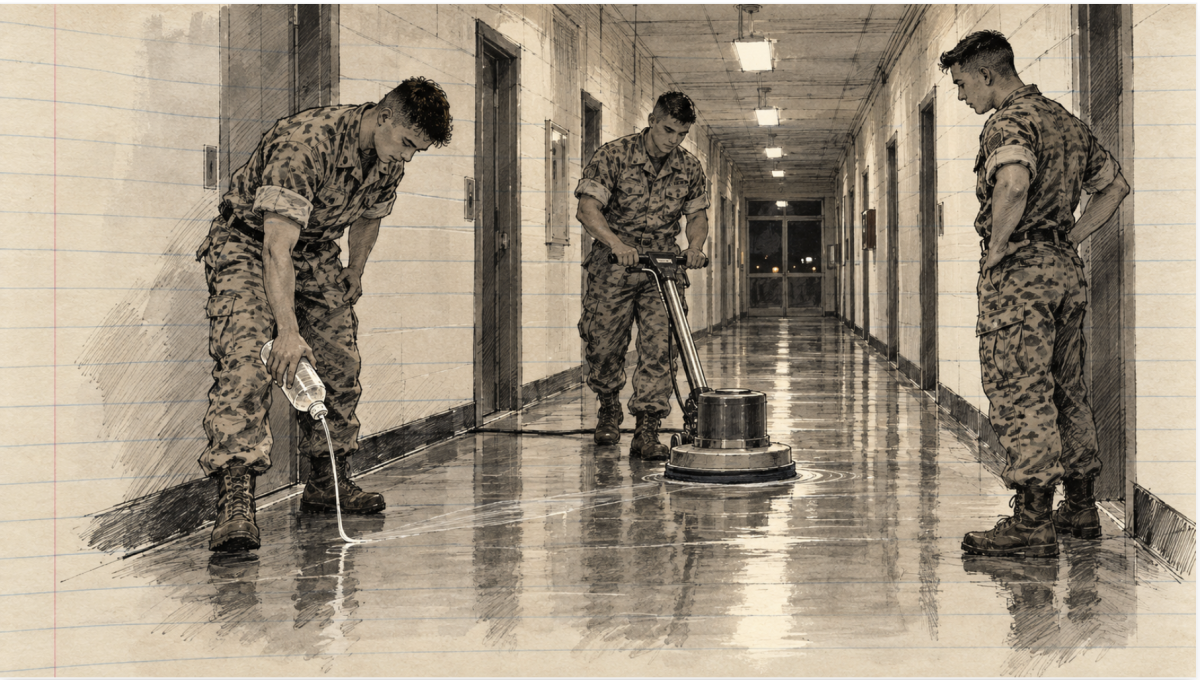
At two in the morning, the hallway floors at 8th & I looked worse than when we started. A few of us had been assigned to wax them before morning inspection. The Marine Barracks in Washington, D.C., is built on precision: polished ceremonies, immaculate blues and a public image of the Marine Corps at its most disciplined. That night, there was nothing disciplined about what we were doing. We were pushing mops through pools of liquid wax, slipping over our own footprints and spreading milky streaks across the deck.
“This isn’t why I joined,” someone muttered.
Most of us had imagined something more tactical when we raised our right hands. Few recruiting videos show a junior enlisted Marine pouring floor wax out of a five-gallon bucket at zero-dark-thirty. Still, we knew the standard. The deck had to be ready by morning. What we had not been given was a step-by-step solution.
After another bad pass, one of the other Marines grabbed an empty water bottle, filled it with wax and punched a few holes in the cap. One Marine sprayed a thin layer across the floor while another spread it. Two more followed with the buffer. Within minutes, we had a rhythm and the deck started to look like it was supposed to. Nobody called an officer or asked for a new set of instructions. We knew what right looked like and adjusted how we got there.
Years later, that is the part of the story I think about most.
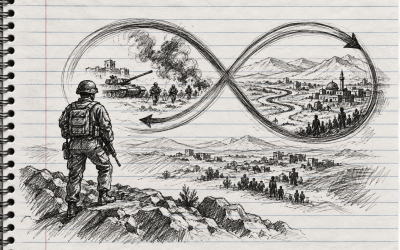
From the outside, military leadership is often imagined as almost entirely top-down. Someone senior gives an order and everyone below follows it. There are certainly moments when that is exactly how it works. Rank, orders and standards all matter. But that picture misses much of what makes a small unit function.
Junior enlisted Marines make decisions constantly. A twenty-year-old lance corporal or corporal may be responsible for people, equipment, movement or security. Waiting for someone higher in the chain to approve every small decision would make the unit slower and less effective. The expectation is not simply obedience. You need to understand the mission, the standard and the boundaries. Within those limits, you are expected to think.
That kind of judgment was not reserved for senior officers. The point is not that rank disappears, but that the person closest to the situation is expected to notice what has changed, understand the commander’s intent and make the next reasonable decision without waiting to be told.
Navigating the Civilian Permission Gap
One of the more surprising adjustments in civilian life was discovering how often capable professionals waited for permission. People with years of training and advanced degrees, often twenty years older than the lance corporal I had been, sometimes felt they had less room to make small decisions than I did at twenty.
I found that frustrating for years. Then I became a principal and realized I could teach people to wait too.
Today, as an elementary school principal, I am responsible for more than 120 employees and nearly 500 students. I am expected to notice problems, protect people, improve systems and answer for what happens in the building. Yet there are moments when something is plainly not working, and changing it still means moving through layers of policy, procedure, approval and competing interests.
Some of that caution is necessary. Seeing a problem clearly does not mean my first solution is automatically the right one. Policies, contracts and due process often protect something important.
But systems can teach people to wait, and so can leaders.
As a principal, it is easy to become the place where every question lands. Someone stops you in the hallway. An email arrives. A decision comes up in a staff meeting. You know the answer, so you give it. It feels efficient and helpful, and sometimes the decision genuinely belongs with me.
But every time I answer a question that someone else was fully capable of answering, I may solve the immediate problem while teaching that person that the next decision belongs to me too.
Once I started noticing it, I saw how often my own habits worked against what I said I wanted. I wanted people to take initiative, but I was quick to answer. I wanted them to use judgment, but sometimes I made asking me feel safer.
At first, I blamed the organizational culture. Then I had to ask whether I was helping create it.
Translating Intent and Directness
That question changed the way I looked at my own leadership. The people I lead are trained professionals. Teachers, counselors, psychologists and support staff are closer to students than I am in the moments that matter most. A principal can define expectations without telling an experienced teacher exactly how to reach it. The expertise closest to the student is often in the classroom, not behind my desk.
I have started asking different questions: What are we trying to accomplish? What cannot be compromised? Does this decision actually need to come back to me, or does it belong with the person standing closest to the problem?
I do not always get that right. Sometimes I answer too quickly because it is faster. Sometimes I hold onto a decision because I know I will be accountable for the outcome. Sometimes I tell myself I am being clear when what I am really doing is keeping control.
The same transition has challenged me in another way: communication.
In one recent disagreement, I was confident in my decision. What I underestimated was how my delivery landed. I was brief and direct. In the military, that kind of communication was often useful. In a civilian organization, the same approach can land differently.
Brevity can remove ambiguity, but without enough context it can also sound like an order. I did not need to become less direct. I needed to understand that how a decision is communicated can affect whether people trust the decision itself. Clarity still matters, but so does context.
Learning how a new organization builds trust, communicates disagreement and earns consensus does not require abandoning decisiveness. It requires translating it.
Veterans entering civilian organizations may have to learn that autonomy is earned and communicated differently outside the military. Veterans who move into leadership roles face another challenge: making sure they do not become the approval structure they once complained about.
That is where the floor at 8th & I still comes back to me.
We were not free to decide that the inspection no longer mattered. We could not lower the standard or ignore the task. But nobody needed to prescribe every mop stroke. We understood what right looked like and had enough room to figure out how to get there.
The floor was not an important mission. It was wax on a hallway.
Years later, I am still trying to create that same balance for other people: clear enough that they know what matters, restrained enough that they can use their own judgment and self-aware enough to notice when I am becoming the permission structure I once complained about.
Eric R. Mace, Ed.D., is a U.S. Marine Corps veteran and elementary school principal in New York. He holds a doctorate in educational leadership, and his work focuses on leadership, organizational systems and creating conditions that allow people closest to the work to exercise sound judgment.