By John Geracitano
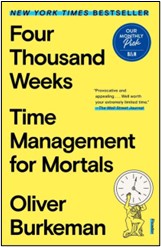
Having three kids at home, time has become my most valuable commodity. This may be why the bestselling book Four Thousand Weeks resonated with my halfway-complete journey of an approximate 80-year life. In a sea of productivity-enhancing time management books, this iteration offers a contrarian approach we all can learn from.
The bestselling author Oliver Burkeman is not new to the self-help space. His previous works include a recurring article in The Guardian entitled “This Column Will Change Your Life” and the book The Antidote: Happiness for People Who Can’t Stand Positive Thinking. His focus on laymen’s psychology, journalistic observational skills, and candid writing combine to create thought-provoking, sometimes humorous content.
Four Thousand Weeks is no different. Burkeman frames his argument in two parts: deciding what is important to us once we’ve acknowledged life’s finitude; then followed by ways to optimize our time, oscillating from existential to traditional techniques. Burkeman’s nuanced approach balances accepting time’s limits and understanding its abstractness–we aren’t “guaranteed” anything. He writes, “The struggle for certainty is an intrinsically hopeless one.” In other words, anything can happen, and it doesn’t matter how much planning and preparation occurs in advance. Maxims like this are where this book adds value, cultivating a philosophical lens through which to view time instead of offering objective management techniques.
While maintaining an existential stance on the temporality of life won’t catapult you to the top of military or C-suite leadership circles, implementing some of Burkeman’s philosophical strategies can’t hurt. Below are three takeaways that might help shape how you view (and manage) your 4,000 weeks.
- The paradox of Hofstadter’s Law. This principle, coined by cognitive scientist Douglas Hofstadter, states that any attempted task will take longer than expected. I make this mistake each time I mow the yard. I confidently proclaim to my wife it will only take an hour to finish and re-enter the house 2.5 hours later, surprised again. The paradox is that even when planners account for this “unexpected” length of task completion, the task still surpasses the given goal. Seems like a lose-lose scenario. Nevertheless, doubling the time you think it will take to complete any given task will generally maintain reasonable expectations for all involved.
- Embrace radical incrementalism. While posited as a principle of patience, this mindset suggests working on a task a little each day instead of occasional long bursts. Framed this way, I have implemented this mindset daily to chip away at long-term efforts. At its core, this has motivated me to work on a project, assignment, or chore when given the chance—even if only ten minutes are available. Incremental chunks add up over time, accumulating into real progress. Authors do this by writing a select number of words daily, notably Stephen King at 2,000 words and Jocko Willink at 1,000. Before long, this incremental progress results in a substantial body of work. Remove any excuses that you need a certain amount of time to finish a task and work on it briefly. It’s not ideal, but the results will show over time.
- You won’t (and can’t) get everything done. Simple advice that most of us already know. But have you fully embraced and internalized this realization? Most of us start the day (or week) with an optimistic task list that we may have already shortened to something achievable. Yet, it is doubtful you will. And more importantly, it doesn’t matter. Fully accept that you cannot complete everything that needs to be done. Ever. Accomplish the most important task one at a time, and some ankle biters will seem insignificant at week’s end.
What I enjoyed most about this book was one of its underlying themes: don’t work too much. This is fresh advice amidst the crowded productivity advice landscape telling us to sleep faster, listen to audiobooks at 2x speed, and work into the night (if you genuinely care about achieving something). Burkeman highlights how the media praised the tireless work ethic of novelist Danielle Steele, who averages seven books a year and only sleeps when she can no longer work. Yet her five divorces and the unfortunate death of her son to an overdose go unspoken. Coincidentally, I just read Arnold Schwarzenegger’s latest book, Be Useful, in which he repeatedly exalts John Coltrane’s work ethic. Coltrane’s wife routinely found him passed out from practicing with the saxophone still in his mouth. I believe such a singular obsession with achievement and productivity is not emblematic of a fulfilled and balanced life.
If John Coltrane’s work habits were translated to the military, he would undoubtedly be promoted ahead of his peers. Similarly, we have all worked with someone who has a cot in their office or shows up to work while on leave. Some situations call for this extreme imbalance in life. But it is not sustainable, and we’re almost always on a team that supports each other, load-balancing the work. This is where the abstract temporal advice Burkeman offers is essential to remember. With a big-picture perspective on life, you will be more at ease with not accomplishing everything on your list, not always getting first place, and acknowledging the uncertainty our futures hold no matter how precise our plans are. Of course, this is not an excuse not to try or not diligently plan, but rather a nuanced vantage point from which to view our lives.
Burkeman’s more traditional tips land on the beaten path of standard advice, ranging from reducing social media consumption, serializing projects, and being more present in daily life—nothing earth-shattering to report. Even still, this book was one of Time magazine’s top 100 books of 2021 and a New York Times bestseller for three weeks, and rightfully so. This book is a sound investment of time if you internalize its key concepts and apply them to your life.
Just as our life is “absurdly” short, so is our time in the military or organization. Incorporating these perspective changes has improved my relationship with time. Yet I still believe the lawn will only take one hour to finish—some things you can’t unlearn.
John Geracitano is a U.S. Army Signal officer currently serving as a doctoral student at the University of North Carolina-Chapel Hill. Formerly an Armor officer, John’s most recent positions include Deputy G6, Brigade S6, and Task Force Operations Officer.