Fighting Wars in Warfighters

Fighting Wars in Warfighters

By Larry Kay

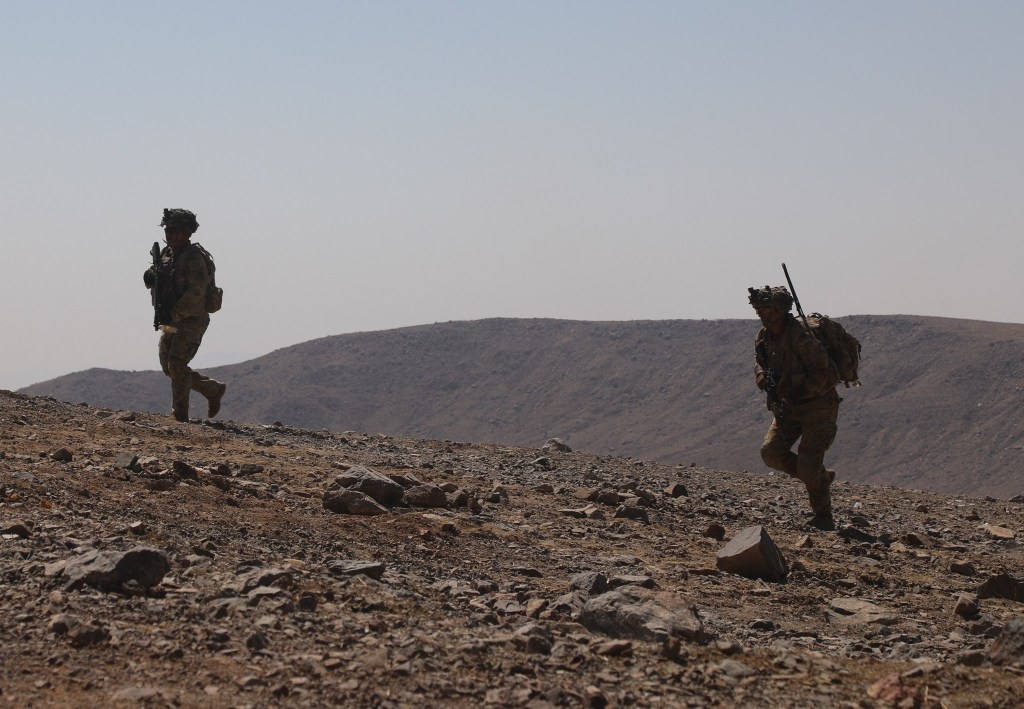
Any Soldier who has been on a division or corps staff knows the value and importance of a warfighter exercise (WFX). For those that do not, a WFX is the principle training event for division and corps staffs; a warfighter is to a division or corps what a CTC rotation is to a brigade. As a result, when a headquarters is scheduled to conduct a warfighter, staffs must prepare for it like brigades and battalions prepare for a CTC. Below are some helpful observations for officers assigned to division and corps staffs preparing for a WFX.

From the Green Notebook’s Top 10 Articles of 2021

From the Green Notebook’s Top 10 Articles of 2021

It’s hard to believe that 2022 is already upon us. 2021 has been a year of milestones for From the Green Notebook and we are truly excited for what the new year will bring. Just this year, we saw Joe and Cassie publish their first book, watched the podcast grow into a hugely successful professional development resource, added five highly talented editors to the team, and published a record number of articles. None of this growth would be possible without you, our authors and audience. 

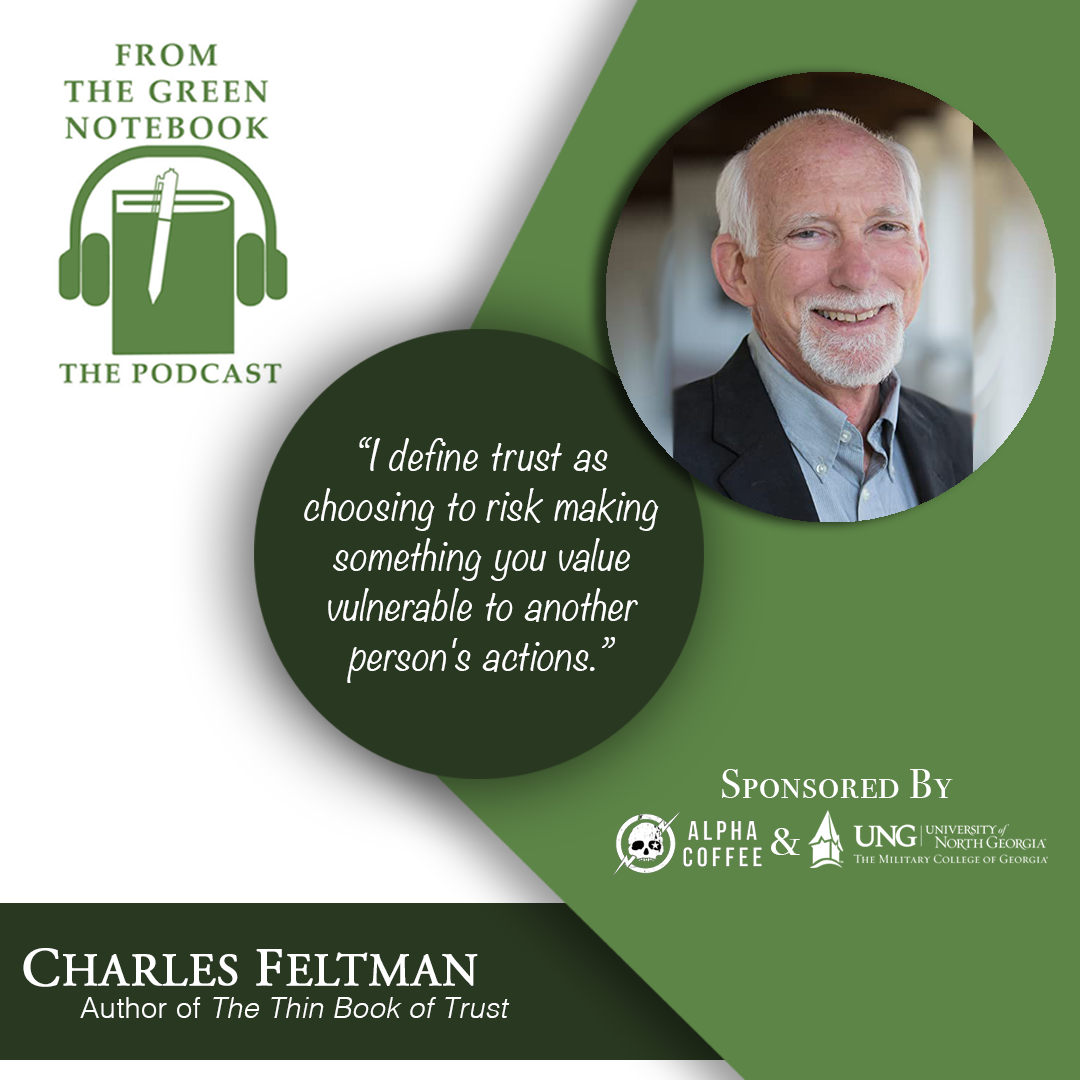
S3,E15: Charles Feltman- The Trust Episode

Charles Feltman, author of The Thin Book of Trust  sits down with Joe and explains how trust is a competency that can be learned, improved, and practiced regularly. They also discuss Charles’ four assessment domains of trust (care, sincerity, reliability, and competence) and why understanding these domains is necessary for leaders to increase team cohesion and effectiveness.

What Modern Day Leaders Can Learn From George Washington

What Modern Day Leaders Can Learn From George Washington

by Chris Horvilleur

George Washington is arguably the most important person in American History. He was an extremely accomplished man and highly competent leader across multiple domains. In fact, he defined what an American leader should look like. Historian Joseph Ellis would state “It seemed to me that Benjamin Franklin was wiser than Washington; Alexander Hamilton was more brilliant; John Adams was better read; Thomas Jefferson was more intellectually sophisticated; James Madison was more politically astute. Yet each of these prominent figures acknowledged that Washington was their unquestioned superior.”  

George Washington was a generalist, he never gave up, he avoided yes- men, maintained a passion for lifelong learning, and was self aware of his own flaws. 

Peer Critical Feedback in Talent Management

Peer Critical Feedback in Talent Management

by Ray Ramos

“You suck, and here is why…”  We all share a desire to know how we are performing.  Kudos are great to hear, but what we really need to hear is how we can be better.  In my own attempt to prepare for the Army’s Battalion Commander Assessment Program (BCAP), I asked a peer to provide me feedback. We spent the last year working closely in a two-star headquarters staff deployed to Afghanistan. Side by side, seven days a week, we grinded away at a difficult mission displaying both our best and worst qualities. In just a little over an hour, we fired hard questions and critiques at each other layered with examples throughout our time together. We used the time to criticize one another with honest candid feedback. This conversation was one of the most enlightening and eye-opening professional experiences of my career. It brought to light shortcomings I was unaware of and defined leader attributes I excelled in. Ultimately, this approach is not something that can be centralized by the Army but must be sought after as a leader and life-long learner.

S3,E14: Kyle Stark- Creating a Culture of Development

Kyle Stark joins the show to talk about his experiences helping professional baseball players and coaches develop their inner and outer game. Kyle shares how he navigated the tension between development and performance during his time with the Pittsburgh Pirates and gives leaders some insights into how they can drive a culture of development for the teams they lead.

The Top 10 Things I Learned as a Battalion S6 at the National Training Center

The Top 10 Things I Learned as a Battalion S6 at the National Training Center

by David R. Mau

Editor’s Note: Throughout this week, we have been running a series of articles from 4-70 AR on their lessons learned at the National Training Center (NTC). Each article is unique in that it presents a different perspective from the organization’s key staff members. Our hope is that these articles will help prepare you for success in your current or future roles in your organization.

The National Training Center (NTC) at Fort Irwin presents a myriad of challenges for the battalion S6; vast stretches of desert and rolling terrain massively degrade line of sight communications, while the merciless heat and flowing sand affect the quality of critical hardware. The opposing force presents constant threats to communications; unsecured command and control (C2) nodes will be captured, artillery will always be targeted at useful Main Command Post locations, and communications jamming will strike during the worst possible moments. Rotational training units facing the desert challenge of the NTC must be proficient in the Command and Control Warfighting Function prior to arrival. This article will touch on methods for training up to and conducting NTC from the perspective of a battalion S6.

The Top 10 Things I Learned as a Battalion Logistics Officer at the National Training Center

The Top 10 Things I Learned as a Battalion Logistics Officer at the National Training Center

by Trae Wolfe

Editor’s Note: Throughout this week, we have been running a series of articles from 4-70 AR on their lessons learned at the National Training Center (NTC). Each article is unique in that it presents a different perspective from the organization’s key staff members. Our hope is that these articles will help prepare you for success in your current or future roles in your organization.

The sustainment warfighting function is a difficult warfighting function to fully train during home station training. As the S4 for a Combined Arms Battalion (A) (CAB A), I learned that this greatly affects our ability to support the maneuver warfighting function. For a unit to succeed at sustainment operations at a combat training center (CTC), especially with a large scale combat operations (LSCO) focus, there must be well-rehearsed battle drills grounded in battle rhythm actions, clear and regular communication, and a healthy ability to be flexible in rapidly changing situations.

The Top 10 Things I Learned as a Battalion S2 at the National Training Center

The Top 10 Things I Learned as a Battalion S2 at the National Training Center

by Kaleb Castillo

Editor’s Note: Throughout this week, we have been running a series of articles from 4-70 AR on their lessons learned at the National Training Center (NTC). Each article is unique in that it presents a different perspective from the organization’s key staff members. Our hope is that these articles will help prepare you for success in your current or future roles in your organization.

During my unit’s recent deployment to the U.S. Army National Training Center (NTC), I learned several invaluable lessons as a combined arms battalion (BN) S2. In an effort to share those important lessons with fellow service members and any other interested parties, I will provide a list of the top ten things I learned.

The Top 8 Things I Learned as a Battalion S1 at the National Training Center

The Top 8 Things I Learned as a Battalion S1 at the National Training Center


by Jed Chan

Editor’s Note: Over the next week, we will be running a series of articles from 4-70 AR on their lessons learned at the National Training Center (NTC). Each article is unique in that it will present a different perspective from the organization’s key staff members. Our hope is that these articles will help prepare you for success in your current or future roles in your organization.

You know more than you think you do. Unfortunately, it took me a few battle periods in “The Box” to realize it. Imagine you are taking a test – months before, you are given the practice test with similar questions and you are able to use a cheat sheet during the test. Now, replace the “test” with NTC; the practice test with your multiple reps at MDMP/FTXs; and cheat sheets with doctrine. You have everything you need to succeed as long as you take a step back and remember everything you have learned and rehearsed. This isn’t to say that there aren’t going to be speed-bumps. No FTX or battle period is the same. Challenges are inevitable. But as a leader, it is what you do to adapt and overcome these challenges that will make you successful at NTC.

The Top 10 Things I Learned as a Battalion Commander at the National Training Center

by Ethan Olberding

Editor’s Note: Over the next week, we will be running a series of articles from 4-70 AR on their lessons learned at the National Training Center (NTC). Each article is unique in that it will present a different perspective from the organization’s key leaders and staff members. Our hope is that these articles will help prepare you for success in your current or future roles in your organization. 

I recently completed a National Training Center (NTC) rotation at Fort Irwin, California as the battalion commander of 4-70 AR, 1st ABCT, 1st AD. I personally learned several lessons that I am still reviewing to inform future training plans and leader development strategies. In the interest of sharing information and creating professional dialogue, please see below for the Top 10 Things I learned through this experience. I hope these points generate conversation and useful leader discussions.