Breaking Down Walls and Building Staff Integration

Breaking Down Walls and Building Staff Integration

Snapshot Leadership

Snapshot Leadership

by Mike Burke

        Think of an image that manifests an emotion, a piece of art or something from your childhood. For example, visualize the iconic picture of the World Trade Center Towers on fire. That draws up emotions; that tragic event forever changed our lives. As the saying goes, a picture is worth a thousand words. Continue reading with the power of pictures in mind.

Don’t Be The Villain!

Don’t Be The Villain!

by Dr. Robb M. Randall

I attended an Air Force sponsored leadership class some years ago, the subject was along the lines of leading through conflict and change.

At that time in my life, I considered myself having superior vision beyond anyone in this particular class (or anyone appointed over me, if I’m being completely honest). Working through an ongoing group exercise, I had a snappy, seriously-funny retort that was guaranteed to get a few laughs and illustrate that superiority (group exercise defined as: the class separated into multiple groups simultaneously working through solutions to the assigned complex problem, the instructor walking through each group’s discussion).

The Family Contract

The Family Contract


by Jason W. Hughes 

Incoming commanders and command sergeants major have spent the last year attending pre-command courses (PCC) to reflect on their values and how they will lead their organizations. One of the most valuable exercises at PCC is the Soldier/spouse family contract – an exercise that forces leaders to think through how they plan to operationalize People First.

Balancing Negativity Bias Among Leaders

Balancing Negativity Bias Among Leaders

by Greg Berry

“If it bleeds, it leads,” so the saying goes in the media industry. News agencies are for-profit organizations, and they know that grim stories get the most attention.

This negative fixation stems from a character trait we all have,  negativity bias. Overall, negativity bias causes us to give more thought and consideration to negative emotions, feedback, and outcomes over positive ones. It’s why we gossip, remember insults from years ago, and give more attention to negative feedback.

Systematic and Gradual: Safely Returning to Collective Physical Training

Systematic and Gradual: Safely Returning to Collective Physical Training

by Alex Morrow 

During the six weeks after the 2011 NFL lockout, players experienced twice the number of Achilles tendon ruptures than the average for an entire season. These were professional athletes doing their best to train on their own, and who likely had access to gyms and fitness equipment. One-third of players who rupture their Achilles never play again. The other two-thirds average 11 months of physical therapy and reconditioning. Although Army physical training and NFL training have different goals, there are similar risks involved in returning to training too aggressively.

Are You Mentally Fit?

Are You Mentally Fit?

by Andrew Klinger

I had just spent another sleepless night on the phone with my First Sergeant getting one of our junior NCOs to a mental health treatment facility. The young sergeant had expressed suicidal thoughts and intent to their spouse, which triggered a crisis response battle drill from us as their chain of command. It was our fifth mental health crisis in three months. Thankfully, in this case as with the others, my First Sergeant and supervisors got the individual the help they needed. There would be no funeral and mourning families this time.

Revisiting the Tape Test

Revisiting the Tape Test

by Summer Lancette

It’s no secret that the Army has a long lasting foundation of standards and regulations. These regulations are in place to ensure Soldiers are physically in shape, but also ensure they are presentable as members of the armed forces. In the United States Army, one method by which these standards are upheld are physical fitness and body composition tests, but at what expense? 

Simply stated, the DoD’s tape test to measure service members body fat composition no longer reflects what we are demanding of our Soldiers’ bodies. 

A Leader’s Guide to Navigating Social Media in the Military

A Leader’s Guide to Navigating Social Media in the Military

By Kristy Bell

Social media has blurred the lines between our private and professional lives in an unprecedented way, and has also, in some ways, eroded the idea of a “non-partisan military” that shores up our democratic ideals.

This came to the forefront recently when several senior military leaders engaged with Fox News host Tucker Carlson over Carlson’s comments about women in the military. The subsequent dust-up prompted some to decry the loss of the customary apolitical stance American citizens have come to expect from its military professionals.

New York City Recruiting Battalion in a Time of COVID

New York City Recruiting Battalion in a Time of COVID

By Lieutenant Colonel Whitney O. Jensen and Command Sergeant Major Latosha Ravenell

Editor’s Note: A version of this article was first published on March 21, 2021 in the NCO Journal

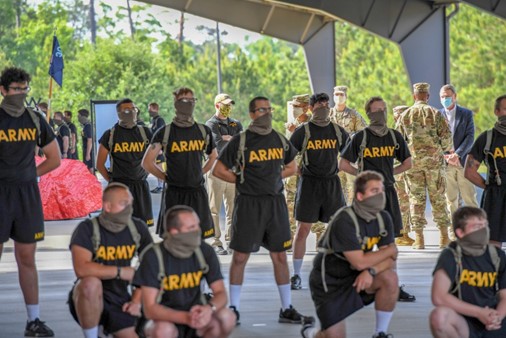
A year ago, in March of 2020, the New York City Recruiting Battalion (NYCRB) faced an unexpected challenge. New York Governor Cuomo declared a state of emergency as the COVID-19 virus spun out of control in New Rochelle. As the world was just beginning to understand the lethality of the virus,  like most organizations, the U.S. military was still coming to grips with how it could contain the virus within the force. Through adaptability, resilience, and strong leadership, the NYCRB overcame the challenges presented by the global pandemic to ensure that America’s men and women volunteering to serve the nation could continue to fill the ranks.  

Choices

Choices

by Dave Leach

“Do you want to continue?” the paramedic asked.  

I was just over three miles from the finish of the Ironman Florida 70.3 race and I was struggling. The 1.2 miles of swimming, 56 miles of cycling, and the 9 ½ miles of running in the heat had taken its toll on me – mentally and physically. Sitting in the back of the air-conditioned ambulance, the thought of accepting the intravenous fluids and being done was enticing. 

Building on Crisis

Building on Crisis

by Matthew Schardt

I am as eager as anyone to get beyond the human and economic suffering associated with the current pandemic. Thankfully, the promise of vaccinations gives me hope that life around the Army and the country as a whole will come to resemble a pre-pandemic “normal” soon.

Even when the country recovers from the worst of the pandemic (and it will), the Army should be cautious not to revert to pre-pandemic processes, practices, and habits. Instead, it should build upon them. Last year’s innovations helped the Army mitigate the threat the virus posed to its mission and people. These same innovations offer the Army opportunities for an improved future.