By Sam Balch
I was serving as a battery commander in the 82nd Airborne Division when our guidon disappeared.
After completing a grueling Joint Readiness Training Center rotation, the battery transitioned to the administrative bivouac area to clean equipment, pack containers, and prepare vehicles for the long movement back to Fort Bragg. My First Sergeant secured a metal barracks building for the battery, marked by our guidon held upright in a rusted pipe mounted to the doorframe. It was not comfortable or impressive, but it met his requirement. Wherever our Paratroopers laid their heads, we would all be there together, from the most junior private to the command team.
The guidon out front did more than mark my location. It declared our home, affirming that this ground belonged to Alpha Battery and the fierce Paratroopers who had fought to claim it. After sixteen brutal days of relentless rain, clinging mud, and bone-deep exhaustion in the JRTC swamps, our Soldiers slept deeply that night, their first true rest in weeks.
The next morning shattered that peace. A section leader shook me awake with the dreaded news: the guidon was stolen, flag, pole, everything gone. My First Sergeant was already stirring, lacing his boots while growling threats for the thief. We formed the battery and stressed that the command team would investigate while everyone else pushed on with prep for home. To me, it was a maddening distraction from the mission. To him, it was a vicious slap against the battery’s soul and every Paratrooper in it but he agreed the priority was getting everyone safely home.
That priority did not last long. Post-breakfast, platoon leadership unleashed Paratroopers in a frantic hunt. Innocent questions turned to accusations; searches grew invasive. Units denying entry faced escalating fury. Shouts became shoves, blame soared unchecked. Junior Troopers stormed adjacent buildings, even battalion command posts, certain the culprit lurked nearby.
When my First Sergeant and I returned to the barracks, the cost was evident. Containers remained unpacked. Weapons still needed cleaning. Vehicles were nowhere near ready for rail. We formed the battery again and made a decision that felt necessary but deeply unpopular. The search had to stop. The priority was preparation and movement.
The disappointment was immediate and unmistakable.
To the Paratroopers standing in formation, it felt as though their command team had given up on them. In their eyes, we had chosen timelines over pride, convenience over principle, and appeasing our higher headquarters over the honor of Alpha Battery. In less than a day, the trust and cohesion we had spent months building began to unravel. Discipline slipped. Suspicion replaced camaraderie. The missing guidon itself was not the cause of that breakdown, but it revealed something uncomfortable about how we understood honor, respect, and loyalty.
I started writing this article in 2022, not long after that JRTC rotation, and then I set it aside. At the time, I told myself it was no longer relevant, or that it was simply a personal frustration I needed to let go of. More honestly, I was not sure it was worth saying out loud. I was not convinced anyone wanted to hear it.
Last week forced me to revisit that decision. Several troop guidons were stolen across my regiment, and with them I saw the same suspicion and erosion of trust I had experienced as a battery commander nearly five years earlier. As I ran in formation with my current battery the following morning, something else stood out. Troop guidons passed by road guards without salutes. What had once been a cultural expectation now felt optional. That realization bothered me more than the thefts themselves. It made clear this was not an old story or a fading tradition, but a norm quietly eroding in front of us, and one I had been silent about. That silence sent me back to the keyboard, convinced that this was no longer just a personal discomfort, but something I owed the Army to say.
We are starting to lose respect for one of the most important symbols in our Army, and as leaders, we seem to be doing little to stop it. In some cases, our junior leaders are actively encouraging its erosion.
This is not an argument against institutional change or growth. Both are necessary in an Army that must adapt to the values and norms of the society it serves. But there are some things so integral to who we are as an Army that we cannot simply accept their erosion as progress.
Why Guidons Matter More Than We Admit
Every organizational culture is shaped by three components: values, norms, and artifacts.
Values are the principles that guide behavior. For Soldiers, those are the Army Values of Loyalty, Duty, Respect, Selfless Service, Honor, Integrity, and Personal Courage. Norms are the unspoken rules that define how members of the organization are expected to behave, what actions are rewarded, and what behavior is quietly excused. Artifacts are the visible symbols of culture. They can appear superficial to outsiders, but they carry profound meaning for those who belong to the organization.
Guidons and colors fall squarely into that last category.
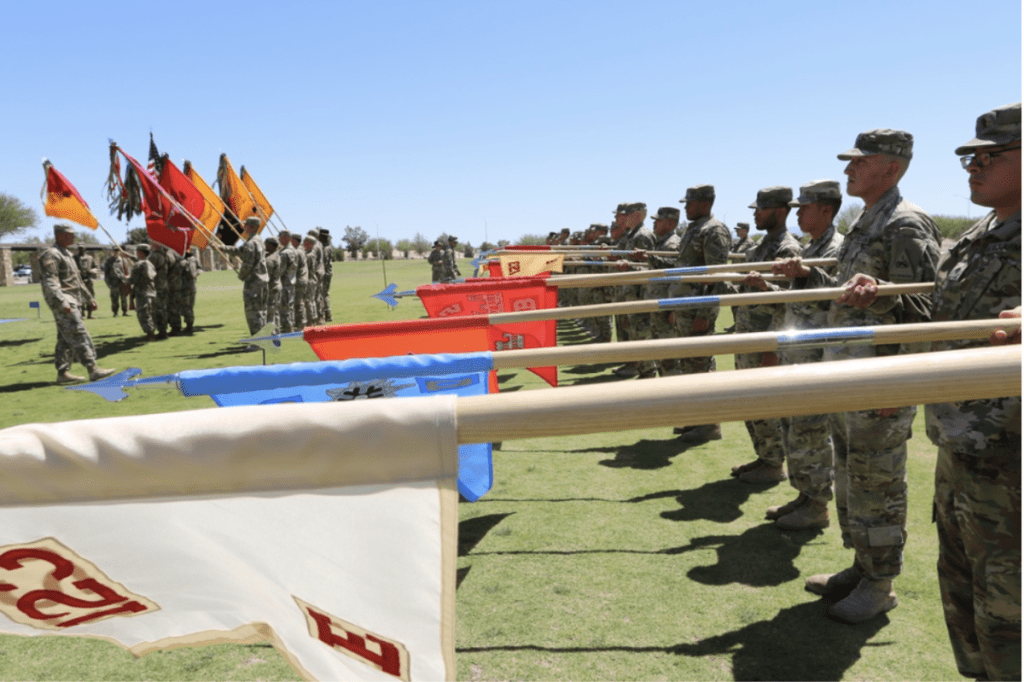
Army regulation defines a guidon as a small swallow-tailed flag, measured precisely and described clinically. That description misses what guidons actually represent. The Alpha Battery guidon I carried from 2021 to 2022 had not changed since 1964. It flew over Paratroopers in Vietnam, Grenada, Desert Storm, Iraq, Afghanistan, and numerous other operations around the world. Thousands served beneath it, some of whom never came home.
Long after commanders change and equipment is replaced, the guidon remains unchanged, serving as a quintessential symbol. It is the physical embodiment of a unit’s memory, sacrifice, and identity. When we treat that symbol casually, we should not be surprised when the values it represents begin to erode.
Why Stealing Guidons Does More Harm Than Good
Stealing guidons has become increasingly common, and in some formations it is no longer treated as a problem at all. Soldiers openly take photos with stolen guidons, hang them on walls, hide them in closets, and share the evidence as if it were a badge of honor. What was once framed as an occasional prank or rivalry has, in many places, drifted into an accepted norm. That normalization is precisely what makes it dangerous.
Stealing a guidon undermines discipline and morale. The guidon represents collective honor, and when that symbol is violated, Soldiers often respond emotionally rather than professionally. In those moments, discipline becomes secondary to pride, and actions that would otherwise be unacceptable suddenly feel justified.
It also destroys trust. Trust is foundational to mission command and to the profession of arms itself. Theft replaces trust with suspicion, blame, and cynicism, both within units and between them. Once that trust is damaged, rebuilding it requires far more effort than the momentary satisfaction a stolen symbol ever justified.
Stealing guidons also normalizes disrespect. Respect applies not only to people, but to what people value. When we trivialize unit symbols, we quietly send the message that traditions matter only when convenient and that respect is conditional rather than foundational.
There are legal implications that are often ignored. Stealing a guidon constitutes larceny under the Uniform Code of Military Justice. Concealing it compounds the offense. While enforcement may be inconsistent, the professional and ethical obligation remains.
Finally, guidon stealing places good Soldiers at risk. Guidon bearers are typically high-performing junior Soldiers placed in highly visible positions. Confrontations during runs and formations disproportionately put them in harm’s way, exposing them to physical altercations and administrative consequences they did not invite. I never participated in a division run where blood was not shed by Soldiers defending their colors, and adverse administrative action almost always followed.
The Line We Are Crossing
Stealing a guidon is vandalism disguised as esprit de corps. Culture is shaped by what leaders tolerate and what they excuse, and if we truly believe guidons matter, then our behavior must reflect that belief, especially when the guidon does not belong to us.
We encourage guidon stealing in the Army until it is our own.
When it belongs to someone else, it feels harmless, even humorous. It is framed as tradition, competition, or esprit de corps. When it is taken from us, however, our language changes. It becomes personal. It becomes disrespect. It becomes a violation of something sacred. That instinctive reaction reveals the truth we often avoid. We do not treat guidons casually when we remember what they represent.
A guidon is not about the commander who carries it today, nor the First Sergeant who guards it, nor the Soldiers currently assigned beneath it. It is not about pride or rivalry or bragging rights. It is about the thousands of Soldiers who came before us. It represents the Soldiers who trained under it, fought under it, bled under it, and in some cases died beneath its shadow, defending its honor. Soldiers like Roshain E. Brooks and Allen L. Stigler, who served in C Battery, 2-319 AFAR and gave their lives in service to their country, are part of what that guidon carries forward. Long after our names fade from memory, the guidon remains as the physical embodiment of their service. Even in death, the unit’s symbol endures as part of their final and eternal identity. Any Soldier who cannot respect that reality has lost sight of what it means to serve in our Army.
This understanding is not new.
In the Roman legions, the standard was more than a marker of formation. It was the soul of the unit. When a legion’s standard was lost, it was not treated as an inconvenience or a joke. Julius Caesar recorded that Roman soldiers would fight through encirclement, accept staggering losses, and even abandon otherwise sound positions to recover a fallen eagle or standard. Not because of personal pride, but because losing it meant a deeply personal dishonor not only to themselves, but to every legionary who had ever stood beneath it. The recovery of a standard was an act of collective responsibility, not individual bravado.
That distinction matters.
The Roman standard was defended and recovered because it symbolized legacy, sacrifice, and continuity. It was not stolen for sport. It was not taken to provoke a reaction. It was protected because it represented something larger than any one Soldier.
Our guidons deserve the same reverence.
When we treat guidons as props for competition, we quietly teach that symbols only matter when they belong to us. When we excuse theft in the name of tradition, we normalize disrespect in the name of fun. In doing so, we place ourselves in direct defiance of the very values we claim to uphold. Stealing a guidon violates Loyalty, by betraying the trust between units. It violates Duty, by prioritizing ego over mission. It violates Respect, by desecrating a symbol earned through service and sacrifice. It violates Selfless Service, by elevating personal amusement over collective legacy. It violates Honor and Integrity, by excusing conduct we would condemn if it were done to us. And it violates Personal Courage, by choosing convenience and conformity over the harder path of doing what is right.
When that behavior inevitably spirals into broken trust, damaged discipline, and unnecessary risk to our Soldiers, we should not be surprised. At its core, the expectation is simple. Guard your own with your life. Treat all others with the respect they deserve.
Not because it belonged to us, but because it belonged to all who served before us, and to those who will one day stand beneath it long after we are gone.
Major Sam Balch serves as the Executive Officer for the Field Artillery Squadron, 2d Cavalry Regiment, stationed in Vilseck, Germany. He has served in the 4th Infantry Division, 82nd Airborne Division, The US Army Field Artillery School, and is a graduate of the USMC Expeditionary Warfare School and Naval War College. He is married to his wife and best friend, Major Sara Roger, an Executive Officer in the 41st Field Artillery Brigade.