By Joe Byerly
Two attorneys stand in front of a judge and jury. They each plead their case. The defense addresses evidence the prosecution omitted, evidence that might cast doubt on the guilt of their client. The prosecution pushes back against the story the defense has woven through the facts of the case. At times, both sides get heated, each painting their role as good against evil, truth against distortion.
Without the defense attorney, everyone would be guilty. Without the prosecutor, criminals would walk free. Neither side owns the truth. Instead, they are part of a system designed to push against itself in pursuit of it.
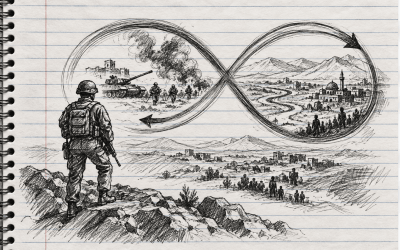
We see this same dynamic when the United States goes to war. It exists in the uneasy relationship between the military and journalists.
I felt this tension in uniform, watching operations I was involved in get reported in the news. It’s not easy to watch something you experienced firsthand and see the facts twisted or, sometimes, simply reported inaccurately. It’s even harder when you see the war you’re fighting questioned. When you’re the one leaving your family year after year, it can be difficult to watch that sacrifice get pulled apart in newspapers and on the news.
But that discomfort doesn’t mean the questions shouldn’t be asked.
Now that I’m retired, I have gained a greater appreciation for that relationship, between the military and those who cover it. Each of those institutions has norms, incentive structures, and pressures that naturally put them at odds.
Journalists operate under their own set of pressures. There’s pressure to get the story, and to get it first. There are editors, audiences, deadlines, and business models. There are political beliefs and institutional cultures that can shape which stories get pursued and how they get told. And when facts are incomplete, as they almost always are during a war, reporters have to make judgments about what those facts mean. Those judgments can be wrong. There are bad-faith actors, of course, but most of this doesn’t require bad intentions either.
In the military, once a policy decision is made by elected and appointed officials, the military is expected to execute it. But what is much harder to describe is the invisible force, the human element, that operates up and down the chain of command.
It’s easy to paint a positive picture of what’s happening on the ground. There’s a pull to tell the boss that things are working. There’s a pull to interpret ambiguous information in ways that support the mission. We all do this in our own lives. We interpret facts in ways that support our version of the story or our existing beliefs, and we tend to discount anything that conflicts with them. It’s one of the bugs in human nature, and it’s present in our military organizations, too. Two people can look at the same set of facts and draw very different conclusions.
Neither institution is free from bias, incentives, or human nature.
Go back to the early years of the Vietnam War. Before the Gulf of Tonkin Resolution. Before American POWs endured years of separation, isolation, and torture. Before more than 58,000 Americans lost their lives. Before the United States spent more than $100 billion fighting the war.
Before all of that, policymakers in Washington were trying to decide how deeply the United States should involve itself in Vietnam. And to make those decisions, they needed to know what was actually happening on the ground.
But getting an accurate picture from the battlefield to Washington wasn’t always easy.
David Halberstam captures this tension in The Best and the Brightest. In the early 1960s, American military advisers were spread throughout South Vietnam, working alongside South Vietnamese forces and reporting what they saw up the chain of command. Some of their assessments were far less optimistic than assessments coming from senior military leadership.
In 1963, after two years in Vietnam, Colonel Porter, one of those senior advisers, submitted a brutally frank final report on the war. His aides encouraged him to add some positive notes. He refused. General Paul Harkins, the senior American military commander in Vietnam, was furious. Rather than circulate the report as was customary, Harkins collected the copies and said it would be “sanitized” before being made available.
Colonel John Paul Vann was another adviser whose view from the ground increasingly conflicted with the more optimistic assessments coming from senior military leadership. By the time he left Vietnam in July 1963, he had become one of the most informed Americans in the country about the war. He was scheduled to brief the Joint Chiefs when he returned to Washington. The briefing was canceled.
And the pressure wasn’t confined to the military. Halberstam describes a Kennedy administration deeply conscious of the story being told about the war. When reporters in Vietnam refused to produce the upbeat accounts officials wanted, the administration generated its own. Optimism, Halberstam writes, became “a major and deliberate part of the policy.” Public relations wasn’t simply describing how the war was going. Increasingly, it was helping shape how Americans understood it.
Outside that system were journalists who could go into the field, talk to advisers, and sometimes report things that ran counter to the official narrative. Of course, journalists aren’t immune from human nature, and many accepted official accounts and statements without asking hard questions. But their independence allowed them to challenge the official line. That created friction. At times, reporters who challenged official accounts found their access restricted. That tension deepened as the war went on. Defense officials even attempted to keep certain publications from reaching troops in Vietnam.
Ann Bryan Mariano, who ran the Pacific edition of the Overseas Weekly, pushed back when Secretary of Defense Robert McNamara challenged the paper’s reporting:
“A newspaper is a living entity with responsibilities and rights. The only people who should judge it are the readers, not timid officials. How can one defend fighting for democratic ideals, as we are the world over, while denying them to our own citizens?”
She was defending her role in the system.
Without friction, we make it easier for errors and biases, human nature to go unchallenged. We risk creating a courtroom with only a prosecutor or only a defense attorney. Neither side is perfect. Neither side owns the truth. We need both pushing against each other in pursuit of it.
That friction can be uncomfortable. And it’s especially uncomfortable when you’re inside one of those systems. Sometimes it can even feel disloyal. But a system without it is far more dangerous.
Joe Byerly is a retired U.S. Army Lieutenant Colonel with 20 years of service, including tours in Iraq and Afghanistan, and command of a cavalry squadron in Europe. He earned numerous prestigious awards, including multiple Legion of Merits, Bronze Stars, the Purple Heart, and General Douglas MacArthur Leadership Award. In 2013, Joe founded From the Green Notebook.
A passionate advocate for self-knowledge through reading and reflection, he authored The Leader’s 90-Day Notebook and co-authored My Green Notebook: “Know Thyself” Before Changing Jobs, a resource for leaders seeking greater self-awareness. If this post resonated with you or sparked any questions, feel free to reach out to him at Joe@fromthegreennotebook.com.