By Jason Ruggieri
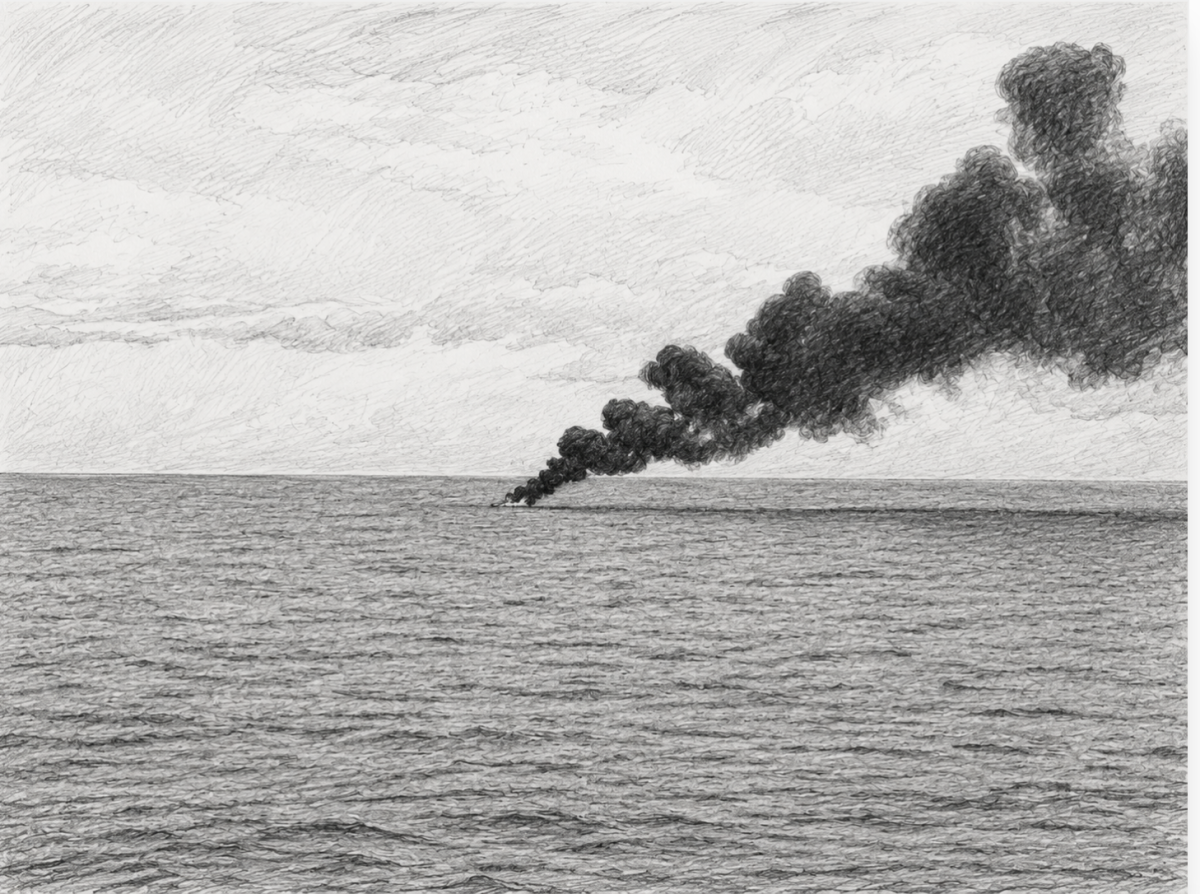
A Coast Guard Boarding Team just denied entry of two million dollars’ worth of marijuana into the United States from an intercepted go-fast vessel somewhere in the Caribbean. As the flames from the sinking go-fast vessel faded with the adrenaline from the day’s events, the real work had just begun.
As the Law Enforcement Officer onboard Coast Guard Cutter Diligence, I had exactly one permanent party member in my division, a junior enlisted Maritime Enforcement Specialist. As just an E4, he was filling two E6 roles in the division left vacant by transfer season. Now, he had to navigate recent policy changes to craft a prosecution-ready case package bound for U.S. interagency and international partners.
It is a grueling task for anyone, even more so for someone who had just spent ten hours on the small boat executing the mission that we leave homeport to do. He came to me, exhausted and sunburned, and expressed his desire to be taken out of the watch rotation to focus on the case package. I agreed with his proposition. However, as a new Ensign just five days into my first patrol, still learning my job, I lacked the authority to grant his request. What I did have the power to do was negotiate for him.
I went to my boss and discussed his request. It quickly turned into a negotiation. After just a few minutes of questions and ensuing discourse, we aligned our interests and reached a deal. He would come out of the watch rotation until he finished the case package. The short and relatively simple conversation was a revelation for an Ensign who had just commissioned less than three months prior.
Despite many mandated leadership forums and classes prior to commissioning, not one of them highlighted the intersection of negotiation and leadership. Conversely, negotiating on behalf of my sole division member was the most genuine leadership moment I had accomplished since the day I commissioned. It was not my authority, or lack thereof, that empowered me as a leader; rather, it was my ability to negotiate.
Every day, junior officers negotiate, whether they are negotiating for time in the Plan of the Day, nominating their team for awards, or requesting that personnel be removed from a watch rotation. Negotiation is not just a skill for business professionals; it is a pivotal component of leadership that must be in every junior officer’s toolbox.
Influence Over Authority
While junior officers assigned to naval ships or Coast Guard cutters are in a role of authority by virtue of their commission, the vast majority are rarely the final decision-makers. Orders come down the chain of command to the Division Officer, who ensures those orders become a reality at the deckplate level. To get the job done, the same Division Officer must influence the petty officers around them to execute the assignment with buy-in and enthusiasm. Junior officers must continuously influence both sides of the chain of command to perform the tasks critical to the mission.
Influence is the hallmark of successful negotiation as aligning interests yields far better outcomes than issuing orders. Influence is not exclusive to working down the chain of command. It is equally paramount for a junior officer to be able to influence up the chain of command. A junior officer is not often in control of ranking priorities or allocating time and resources, yet they still must produce results. Due to this, junior officers must negotiate with those senior to them to gain the necessary time and manpower required to accomplish their tasks.
Genuine advocacy and effective communication are critical in confirming that the command knows that the job will get done while also guaranteeing that those executing the job at the deckplate level are best equipped with the time and resources that are available. Building one’s credibility and fostering relationships are critical to a junior officer’s ability to negotiate for their people up the chain of command while also being able to influence down the chain of command to obtain results that far exceed the bare minimum for mission execution. Negotiation should be a required course for junior officers as negotiating and influencing those around you are often far more consequential than issuing orders.
Teach the Talk
Often, courses at commissioning sources focus on preparing budding junior officers to lead with authority and overemphasize the decision-making role that junior officers have during their initial tour. Navigation classes provide repetitions for running a bridge team, mock leadership roles teach the rigidity of a command structure, and leadership courses hammer the importance of theories such as Tuckman’s model. However, these efforts miss the mark of preparing junior officers for the reality of their first assignment, where authority and decision-making are secondary to negotiating and influencing within the chain of command.
Negotiation as a leadership strategy is not a revolutionary concept. Many elite institutions require negotiation courses for individuals pursuing business management degrees. Furthermore, institutions have dedicated negotiation think tanks and sponsor world-class speakers on the subject. If the best-ranked universities in the world are teaching the up-and-coming leaders of the business sector about negotiation as a leadership strategy, why are the future leaders of the military not required to learn this valuable lesson?
The idea that negotiation is a cornerstone of effective leadership, specifically for junior officers, is not new to the military. At West Point, over a thousand cadets have learned the fundamentals of negotiation and can choose to take an advanced course through their Negotiation Center of Excellence. The Air Force has a dedicated Negotiation Center open to all active-duty members, providing an opportunity to learn this vital skill. Yet, the Sea Services lag behind.
The stakes for negotiation only compound as one becomes more senior in their career. Eventually, officers are expected to negotiate; however the stakes are often much higher than a watch rotation. For instance, senior officers negotiate with industry leaders while finalizing service-wide contracts and with legislative officials when showcasing the need for additional funding. Oftentimes, these skills are self-taught out of necessity.
In June of 2025, the Coast Guard updated its Leadership Development Framework to include negotiation as a core leadership competency for junior officers. While this is a step in the right direction, without incorporating courses into the leadership development curricula, whether at commissioning sources or at standalone classes at the Service’s Leadership Development Center (LDC), it is merely action without direction. Furthermore, despite the Coast Guard highlighting negotiation as a crucial component of leadership, it is absent from the Midgrade Officer and Civilian Transition Course, which specifically targets junior officers, and their civilian equivalents, as they progress in their careers.
The logistical foundation for these courses to take place is already present. There are dedicated classrooms and billeted instructors who could teach negotiation courses to all cadets and officer candidates at the Coast Guard Academy and the co-located LDC, which oversees Officer Candidate School. If the Coast Guard has stated publicly that negotiation is a foundational component of leading others, then why are these skills not being taught to all junior officers? Negotiation is a key skill to possess as a leader at any stage of your career, yet it is not required to be taught formally to officers in the Sea Services.
Clearly, there is a disconnect between the Sea Services and their Sister Services. Both the Army and the Air Force have dedicated classes and programs for negotiation training, whereas the Navy and the Marine Corps make no mention of negotiation in their leadership publications. Our Sister Services recognize the efficacy of negotiation when done right and value the practical leadership development of their junior officers by equipping their members with the skills that will only grow in importance throughout their career. By contrast, the Sea Services fail to realize the value of training interest-based communication and conflict resolution through negotiation.
It is time that the Sea Services incorporate negotiation courses into the curriculum at all officer accession sources. This low-cost, high-value addition to preexisting leadership development curricula would enable officer candidates and midshipmen to grow in their ability to influence and negotiate prior to hitting the fleet as commissioned officers.
Getting reps in a controlled setting is already a crucial part of officer candidates’ instruction; hours of training in navigation simulators are required before taking the Conn for the first time. Yet, there is no requirement when it comes to learning how to negotiate. It is imperative that officer accession sources teach tomorrow’s decision-makers to lead and influence through negotiation, a skill that lasts a career.
While the go-fast may be at the bottom of the ocean, the lessons learned from that day continue to remain at the surface. Junior officers are entrusted with leading enlisted men and women under them; however, they must also strike a balance and lead up the chain of command through negotiation. Influence and negotiation are not merely soft skills,rather they are the hallmarks of fostering buy-in and achieving results that surpass expectations.
As the spotlight on the maritime domain continues to shine brighter, it is time for the Sea Services to take a comprehensive look at the leadership development curricula they employ for the education of their junior officers. In doing so, the Sea Services must realize that negotiation is a fundamental skill for an officer and ought to create avenues to ensure that this skill is taught formally to every future member of the wardroom.
Jason Ruggieri graduated from the United States Coast Guard Academy in 2025. He is assigned to a Medium Endurance Cutter in Pensacola, Florida. Originally from South Jersey, he is a die-hard Philly sports fan. He can be reached via LinkedIn.