


by David Kahan
My time at the Captain’s Career Course (CCC) was a disappointment.
Arriving at Fort Huachuca, Arizona in April 2022, I hoped that Military Intelligence CCC (MICCC) might help either to prepare me for my next position or teach me useful skills that could be broadly applied within Military Intelligence (MI).
Neither proved to be the case.
Instead, I was met by a poorly designed course that left all attendees that I spoke with feeling unprepared for their follow-on assignments. It was not only difficult to engage with material that is of little use to our military careers, but even more so in an environment that diminished our experience over the past three to four years in leadership roles. This was exacerbated by the Army’s requirement that officers planning on separating within the next two years still attend. The end result was an expensive Army investment that seemed to only increase officers’ desire to separate as soon as possible. But perhaps the most frustrating part of all is the knowledge that the Army does have the resources to provide a more enriching, engaging and overall worthwhile educational experience.
My frustration with my experiences led me to want to understand CCC as a whole: its purpose(s), mission statement (if any), authorizations, and organization. A course that I imagined would replicate graduate level education (all attendees being 4+ years post BA) is taught like high school. Slides and tests are set, learning outcomes determined by a board which instructors have no seat at, and change is slow. As I looked into my CCC experience, a much larger bureaucratic system came into view. I found a patchwork of vague regulations and intertwined proponents struggling to both modernize the course and define its purpose. Just as I don’t believe MICCC succeeded in preparing me for my future assignments, I’m not sure I’ve fully grasped its role in further developing officers.
Therefore, let this be a starting point for further conversation about the specific components of CCC that are clearly inadequate followed by a few major takeaways and suggestions for a more productive and in general, more meaningful, road ahead.
The Intended Purpose of CCC: A Brief History
In my search for the purpose at CCC, I decided a review of the past was a good place to begin. Understanding what was meant to be with CCC allows a clearer analysis of its shortcomings. Attendance at the Captain’s Career Course is an officer’s first (and only) step into the Mid-grade Learning Continuum (MLC). The MLC is a product of the 2010 Professional Military Education reform kick-started by then-Training and Doctrine Command (TRADOC).
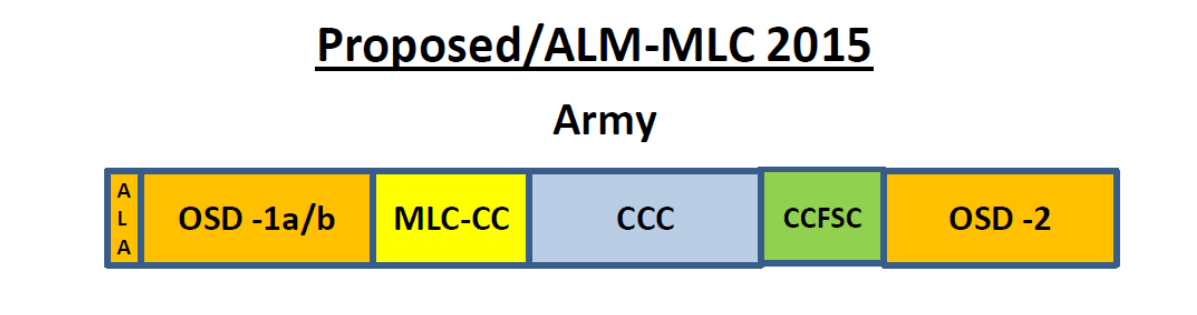
TRADOC is the overall proponent for CCC and has delegated to each branch’s Center of Excellence the responsibility to create their own technical/branch curriculum for the course. As a result of a 2010 study of CCC instruction, the School of Advanced Leadership and Tactics was created at the Combined Arms Center to develop the MLC. Their proposal had officers undertaking a sequence of courses.
The original proposal had five blocks that can be seen in the image below and were aimed at intermediate leader development. However, despite the original design, the ‘continuum’ now only involves one dedicated course – CCC. Gutted, the MLC means nothing today and while the proposed model might have been beneficial, its continued existence in the regulation is a mirage.
What, then, does doctrine say about the Captain’s Career Course? Besides describing basic administrative requirements, it simply states that CCC:
Provides [Captains] with the tactical, technical and leader knowledge and skills needed to lead company-size units and serve on battalion and brigade staffs. The course emphasizes the development of leader competencies while integrating recent operational experiences of the students with quality institutional training. It facilitates life-long learning through an emphasis on self-development. The curriculum includes common core subjects, branch-specific tactical and technical instruction, and branch-immaterial staff officer training.
These vague words are the only guidance which regulation provides concerning CCC’s purpose or mission. Although this does provide maximum flexibility to Centers of Excellence to innovate, I have seen no examples of this.
Concurrently, TRADOC has charged the Combined Arms Center with the development of a Common Core curriculum that officers receive at the beginning of their CCC. Combining this with each Center’s branch/technical instruction in sequence is what yields the CCC experience that every officer goes through today.
In 2015, the Combined Arms Center created ArmyU to manage the Common Core curriculum on its behalf. What does this change mean? Any curricular updates are a convoluted process that requires over twelve months to implement anything significant. Branch-specific changes to curricula are an equally slow, cumbersome process.
What comes next? “Modernization”?
The last modernization of CCC took place in 2004-5 when today’s Common Core was created and the course shortened from 24 weeks to 20. Officers starting CCC after April 2023 will experience the first “modernization” of CCC in 17 years. As laid out in the “Captains Career Course Modernization Initiative White Paper” from January 2022, Common Core instruction will change dramatically. 240 hours of in-person Common Core instruction (6 weeks) are reduced to 72.5 (2 weeks) with the remaining time being given back to Centers of Excellence for more technical/branch-specific instruction. This reduction is paired with the creation of a required 74.5 hour Common Core Distance Learning Course to be completed prior to reporting to CCC and available through the Army Learning Management System upon promotion to 1LT. Additionally, all Centers of Excellence are redesigning their CCC technical/branch instruction programs to incorporate a new scenario centered on the Pacific, rather than the current model that focuses on Eastern Europe.
My primary takeaway from this modernization is further frustration and confusion in the system. Although it shortens Common Core instruction (certainly boring and worthy of cutting), the new CCC modernization will not implement a more efficient or productive course experience for participants. While I would like to believe that my branch’s Center of Excellence will effectively utilize the extra time to teach skills that will be helpful, my experience at MICCC does not leave me with any confidence in this – my issue with MICCC was never that it was too short – the material and curriculum itself was poor.
Conclusion
So where do we go from here? There is no solution for the issues that I encountered but I would propose two solutions that could begin to hack away at the institutional issues.
First and most importantly, the Army needs a new formula for creating and updating curricula as well as appropriate personnel for carrying out curriculum development and instruction. It is apparent that along with being mostly led by civilians, officers involved with curriculum development have no specialized or formal training in the subject. Moreover, the Army’s ability to develop curricula appears to be extremely limited as ArmyU outsourced the development of the Common Core Distance Learning course in 2022 to a contractor team. This decision is surprising and even concerning given the depth of training, knowledge, education, and experience residing in the combined faculties of the DOD which include the United States Military Academy, Army War College, National Defense University, and National Intelligence University. If these repositories of skill and experience are unable to shoulder the burden of curricular development for, at a minimum, all resident Army officer courses, then the Army should look to create a new functional area dedicated to this crucial task supporting TRADOC.
Second, the Army should easily allow officers who believe that they do not wish to continue service to opt out of CCC and still move forward with their next change of station. Regulation states that officers should attend CCC before the end of their 7th year of service, however Branches do not allow that flexibility. They treat attendance as a requirement prior to moving to a second duty station. This means that officers whose initial commitment runs past 4 years but plan to leave the army within the next two years spend over 6 months attending a course they do not want to attend and will never utilize. Units may prefer to not hire officers who indicate that they will not attend CCC, however forcing multiple moves in a short span of time does not help retention and is an expensive waste of resources.
Allowing officers who intend to separate to decline Professional Military Education and yet still move to another duty station will save the Army and its Soldiers money and provide the Army an indicator of whom to focus resources on. These officers will still be able to attend CCC prior to the end of their 7th year of service if they change their mind. Beyond saving resources, this would also ensure that the officers who do attend CCC want to be there, increasing general motivation, work ethic, and learning.
But these two solutions still fail to address a simpler question. What constitutes success for CCC? Is it a course that makes an officer more likely to stay in the Army? Or is it an officer who receives a Most Qualified evaluation in their first key development position following CCC? Where does the emphasis lie between subject matter knowledge and critical, creative, and adaptive thinking? The answer to all of these requires the Training and Doctrine Command, the Combined Arms Center, and all Centers of Excellence to establish clear, specific goals for the CCC experience. Until then, CCC will remain a source of frustration to those Captains who stay in and will continue to drive other Captains to leave the Army.
CPT David A.B. Kahan is a military intelligence officer and recent graduate of MICCC. He is now stationed in Vicenza, Italy and was previously an intelligence officer with 1/10 MTN DIV.
The views expressed in this article are the author’s own and do not represent those of the United States Army, Department of Defense, or From the Green Notebook Team.


