By Kyle McCarter
Not everyone gets the chance to grow their lore, legend, or earn a cool scar. But I was blessed with such a day in the summer of 2005.
It was a regular, hot, humid, and rainy day in Florida. I was stationed at Camp James E. Rudder, Eglin Air Force Base on Florida’s Panhandle, where the 6th Ranger Training Battalion (6th RTB) runs the third phase of Ranger School, Swamp Phase. If you have never had the opportunity to visit this lovely camp, it is 23 miles off the main road, buried deep in snake-infested swamps and black bear-filled pine forests.
I was a Specialist in the 6th RTB, a unit where 75% of the population are Sergeants First Class (E-7s) or Captains (O-3s). Those O-3s and E-7s are all Ranger qualified, and most of them are combat-tested. They are hard-as-nails leaders — the instructors charged with training and certifying Soldiers and leaders as Army Rangers. It was truly a special mission to be a part of.
So, you might be asking yourself, “Why is a skinny, little, 22-year-old Specialist here with all these badass Rangers?” As an Infantryman, I was here as a “River Rat,” part of the 6th RTB’s Boat Platoon — a crucial portion of every Ranger’s experience at Ranger School. The River Rats owned and operated all the zodiacs and watercraft the Ranger Students used in the final phase of Ranger School. The River Rats secured the swamps, rivers, and beaches for each waterborne movement of the Ranger School’s infamous swamp phase. We pushed the hunters and fishers out of the training area. We wrestled alligators, kissed cottonmouths, and got stuck in the mud of the Blackwater River.
Our most important task, however, was to save lives. Each River Rat went out on the water with a Combat Medic. The two of us (usually lower Enlisted) were the first responders when a Ranger Student or Instructor had a medical emergency. We would strap on our night vision goggles and hurry down the river in our twelve-foot outboard to the point of injury. As we flew down the river, we were on a push-to-talk radio with the Ranger Instructor, gathering details about the injury while simultaneously calling in our initial nine-line medical evacuation (MEDEVAC) request to headquarters via our Manpack Radio.
Upon arrival, we loaded the casualty into our watercraft, and the Combat Medic began life-saving steps while I piloted to an open portion of the river. I finished calling in the nine-line MEDEVAC request to the en route UH-60M Black Hawk helicopter while securing the boat to the near and far shores via a rope bridge. While the casualty was being stabilized by the Combat Medic, I communicated with the pilots over the radio and marked our location for them to see, shooting off a star cluster for far-sight recognition and spinning an orange chem light for near-sight recognition.
The MEDEVAC helicopter arrived over our heads, soaking us in its rotor wash, and lowered its jungle penetrator to our watercraft. We secured our casualty to the jungle penetrator, which lifted the casualty into the belly of the aircraft. Just like that, we were left to our thoughts in the black of night and the cold silence of a hushed swamp. Just me and the medic, with a combined time in the Army of less than four years.
Six hours later, we were relieved at our riverine post and began the slow movement back to the Platoon bay. We cleaned our gear, conducted inventories, charged our radio batteries, submitted repair requests, zeroed our radios, secured our sensitive items, and filled out an after-action form for the MEDEVAC we had just executed.
The Ranger Instructor responsible for the Ranger Student we had just evacuated stopped by the Platoon bay to pat us on the back for that night’s actions. It was one of the greatest feelings of my career up to that point.
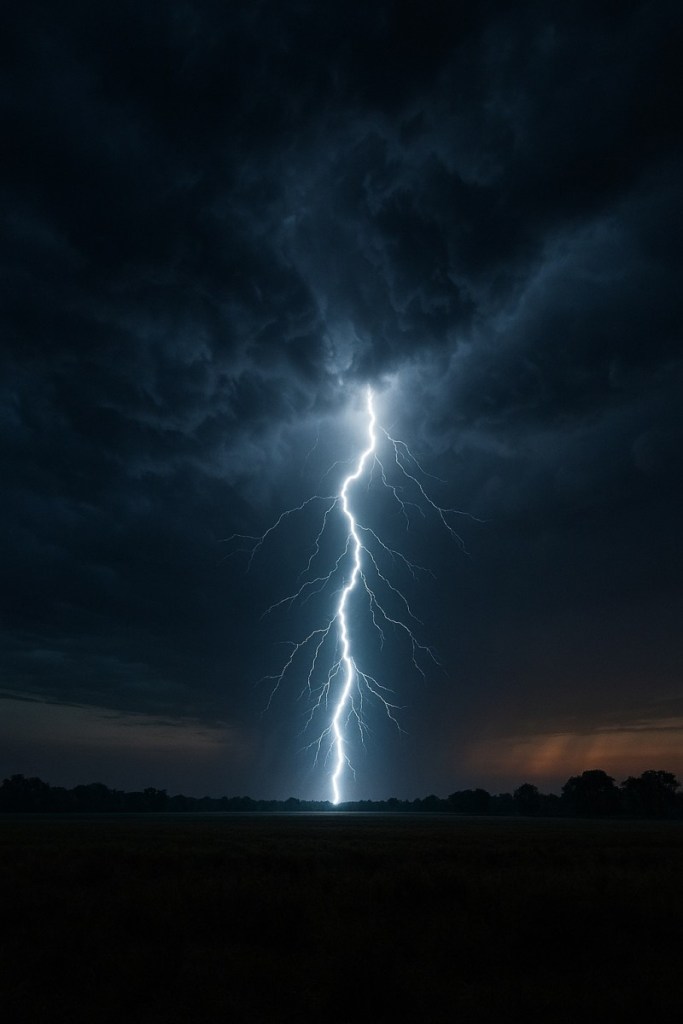
As the medic and I walked to our barracks in a light summer rain, the air charged with electricity. The hair on our arms, legs, and necks began to rise. The air was superheated around us and rapidly sucked out of our chests. Our world turned pure white, and we were blinded in a flash. A thousand symbols crashed in my ears, ripping through my skull. We were thrown through the air, landing unconscious.
As the lightning threw me, I thought two things: First, this is epic. Second, I will be fine.
Living through the lightning strike taught me several lessons that have continued to impact my service in the Army.
First is the need to always be ready, that conflict or disaster can happen at any time, and you need to be able to fight tonight. Even though we had been struck by lightning, we knew we were surrounded by professionals, warriors who trained hard every single day to react to contact, to save lives, to drive through adversity. Men who had a primary, secondary, and tertiary plan for everything. Soldiers who were masters of their equipment, weapons, and craft.
The second lesson is being physically and mentally tough. That singular event in my life cemented the need to train for the extreme, prepare your body and mind for the unexpected, and maintain a killer spirit in your actions on the objective. Knowing that I can overcome hardships, severe weather, and pain—mentally and physically—has paid dividends over the years. This is the same mindset that prepared those around me to save my life.
Third, and most importantly, is ensuring the next generation of young Soldiers are empowered, ready, trained, and confident in their skills. The men who were first on the scene of the strike were all junior enlisted Soldiers. They were all trained and ready to act in the face of adversity and were heroes that morning in 2005.
We did not simply live through the lightning strike; we thrived.
Kyle McCarter, U.S. Army, is a Military Intelligence Officer serving in the U.S. Army Pacific Area of Responsibility. He is currently the Senior Intelligence Officer at the Joint Pacific Multinational Readiness Center. He and his team are responsible for creating hard and realistic training via an accurate Operational Environment and Opposition Forces during Combat Training Center exercises across the Pacific and Arctic.