by Garrett M. Searle
In 2014, Admiral William McRaven, then Commander of U.S. Special Operations Command, made a famous speech at a commencement ceremony for his alma mater, the University of Texas. The thesis of his address was the importance of the little things in life: “If you can’t do the little things right,” he said, “you’ll never be able to do the big things right.” The speech is most famous, however, for its injunction on making your bed. “So if you want to change the world,” he says, “start off by making your bed.” His message is like a ‘broken windows’ approach to your personal and professional life: summon order from the chaos of your bedclothes, and it will empower you to accomplish other things too.
When it comes to making the bed in our house, my wife and I have a deal: whoever gets up last is on the hook. This particular household regulation was instituted by my wife about 10 years ago, mostly because she knew it meant 99% of the time it would be me making the bed. She’s a dedicated runner who gets up early to log 8-10 miles a day before work. So, in our house, bed-making has become a penance for laziness. On the rare occasion I do get up before she does, I sure as hell don’t make the bed.
Since for me the chore of bed-making is a domestic obligation, I’ve found myself looking elsewhere for McRaven’s mystical motivation to ‘get one thing done so I can get other things done too’ (I’m paraphrasing). My job in the Army requires me to be physically fit, so I’m drawn to the routine of physical training (PT) as this source of inspiration. As it turns out, PT is a more effective example of doing “the little things right” because it has the same powerful impact as bed-making but with actual, tangible rewards.
Here’s my philosophy: in the Army, PT is like making your bed but better, because it has four important benefits for you and your unit. First, as an individual, it trains your body and prepares you physically for the rigors of combat. Second, it trains your mind to accept things that are hard and keep going. Third, it gives you the opportunity to build leaders through the basics of training management. And lastly, it builds your team, increasing cohesion and trust. These benefits, collectively, are why we do PT and why we (mostly) do it together as units and teams.
Before I describe those benefits in more detail, however, I want to look briefly at the culture and doctrine of Army physical training. In the latter half of my service in the Army, I’ve spent the majority of my time in non-standard units where daily unit PT is not a given. Consequently, I’ve also spent more and more time explaining why I think unit PT, done together, is so important. So what is driving my growing need to push back against disaggregated PT?
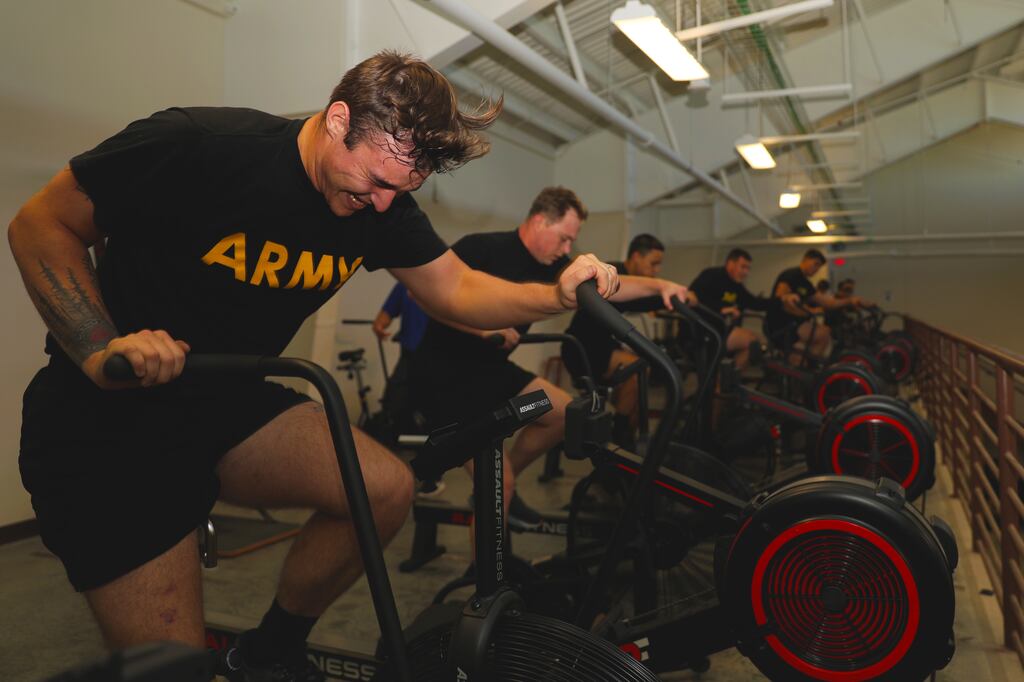
Certainly, there have been some big philosophical and doctrinal changes for physical training in the Army over the last decade. When I joined the Army 19 years ago, we never saw the inside of a gym (or a barbell for that matter) during PT hours. We did a lot of running, rucking, and calisthenics, with combatives mixed in occasionally. Take a jog down Ardennes Street on Ft. Bragg today, and you will see a different scene: the running and rucking are still there, but also squads and platoons gathered around containers with barbells, plates, sleds, and kettlebells spilled out onto the tarmac behind every company area.
This is a great development and, in my limited observational experience, has led to a more physically well-rounded force. My criticism, however, is that the accompanying doctrine trends toward overemphasis on the individual. In fact, “individualization” is one of the three core principles of the holistic health and fitness (H2F) system. This may be why I’ve seen an increase in demands to ‘do PT on our own.’ Individualization is great (for the individual), but it is unrealistic for commanders to manage effectively, creates unnecessary tension within units, and erodes the other benefits of collective unit PT.
As an Army, we need to tip this focus back in the other direction—to find what is a sufficient level of individualization (using scaling and ability groups, for example), while maintaining an emphasis on collective unit fitness and capability. If we can do that, we maximize all four of the benefits of physical fitness training.
The Four Benefits:
1. Train your body. This is the most obvious benefit of any physical fitness activity, no matter where, how, or with whom you do it, so I won’t dwell on it at length. However, it is still the main reason physical training is an integral part of the profession of arms—combat is hard and unforgiving, placing unique demands on the human body. Soldiers must be prepared to move long distances under load, carry or drag a casualty to safety, lift heavy ammunition or supplies, or complete any number of other physically demanding tasks.
In a 1966 address to the U.S. Army Command and General Staff College, General Matthew B. Ridgeway, the first commander of the 82d Airborne Division and XVIII Airborne Corps, mused on the characteristics of good Army leaders. He counted a high level of physical fitness among the competencies of strong leaders, laying out his standard for commanders of large units. In his view, a division commander “should have the physical endurance, stamina, and reserves of his best infantry battalion commanders, because that is where he belongs—with them—a good part of the time.” That’s a tough standard, and if you follow that logic, those battalion commanders need to match the physical aptitude of their best platoon leaders and company commanders, because that’s where they belong.
Meeting that standard requires daily vigilance since, as GEN Ridgeway implored, “no one can predict today when you may be thrown into combat, perhaps within hours of deplaning in an overseas theater.” This remains the most important reason for good PT habits: do the work now so you are physically ready when called.
2. Train your mind. In addition to the physical benefits, good PT has a secondary mental benefit. This is not the “runner’s high” that some folks get from exercise. I’m talking about the choice that every tough workout gives you: throttle up or throttle down. Quitting is an ugly word, but that’s another way to put it: every challenging PT session gives you the opportunity to quit, to back off, to choose the easier path. I’ve done it, you’ve done it, we’ve all done it. Maybe you slept poorly the night before, maybe you didn’t drink enough coffee (or forgot your pre-workout, or whatever), maybe you’ve got no excuse and you’re just not feeling it that day.
Whatever it is, the choice is always there, and the more you present yourself with that choice when surrounded by your teammates, the more opportunity you have to get it right. Working out in a group context increases the likelihood that you will choose not to quit—social pressure works in your favor by helping to grow your ‘I’m not going to quit’ muscle. Of course, good leadership ensures this pressure is constructive and doesn’t lead to injury. Consequently, it also improves physical outcomes because you are pushing harder or working out for a longer period. All of these are individual benefits that are amplified through team-based physical training.
3. Build leaders. Those individual-level benefits are great, but there are also some important organizational impacts we gain from doing PT together. The first is the opportunity to develop junior leaders. PT is the most basic form of training we do in any Army unit, so it is tempting to ignore the basics of training management that we apply to more complicated events. But the essential components are all there: good PT requires planning, resourcing, preparation, and leadership during execution. It also benefits from an after-action review and the application of lessons learned to future training. Assigning these leadership tasks to junior leaders—and then mentoring them through execution—builds muscle memory for the eight-step training model and the basics of training management. Those basics are the foundation for the management and execution of much more complex training.
4. Build your team. Lastly, conducting physical training together is one of the best ways to build strong teams. In my view, tough, rigorous PT is the foundation of every good Army unit, and doing hard things together can build a solid foundation of cohesion in any organization. This is an extension of the individual mental effect described above, where members of a team push each other and build trust based on common struggle.
One of the best examples of this dynamic in popular culture comes from the movie Miracle, based on the true story of the American national hockey team’s triumph over Russia in the 1980 Winter Olympics. In one impactful scene, coach Herb Brooks is frustrated by his team’s performance in an exhibition game against Norway. He keeps them on the ice after the game to skate sprints over and over again to the point of total exhaustion. The torture ends when the players begin to realize that the only path to winning requires pulling together as a team: “When you put on that jersey,” coach Brooks says, “the name on the front is a hell of a lot more important than the one on the back.”
The movie reinforces the idea that you can’t manufacture cohesion and trust overnight—leaders have to build it. There is no better way to start the process than through tough physical training at the beginning of each day. If you don’t get anything else done that day, you know you’ve accomplished this one thing with all these positive benefits for you and your team.
So get up, make your damn bed, and then join your team for a good workout—you (and they) will be glad you did!
LTC Garrett Searle is a U.S. Army Civil Affairs officer, currently serving as the Commander of Headquarters and Headquarters Battalion, XVIII Airborne Corps.