By Joe Byerly
A dozen eggs costs about $3.
A value meal at McDonald’s? Around $5.
A Friday night movie ticket? $17.
These prices are tangible. We know them before we walk into the store, pull into the drive-thru, or pick someone up for a night out. If I asked you if you wanted any of these, you could quickly do the math in your head and say yes or no.
But if I asked, “Do you want to be great at [insert your thing here]?”—that’s a harder equation.
When we chase greatness, we rarely stop to ask what it’s going to cost. We think we can have our cake and eat it too; that we can stay comfortable while pursuing something extraordinary.
Maybe that’s greatness’ trick: it lets us believe it won’t hurt. Because if many of us really knew the cost, we might never start.
I know I didn’t ask how much it would cost—not for the longest time. Every time I set out to be great at something, I focused on the goal, not the trade-offs.
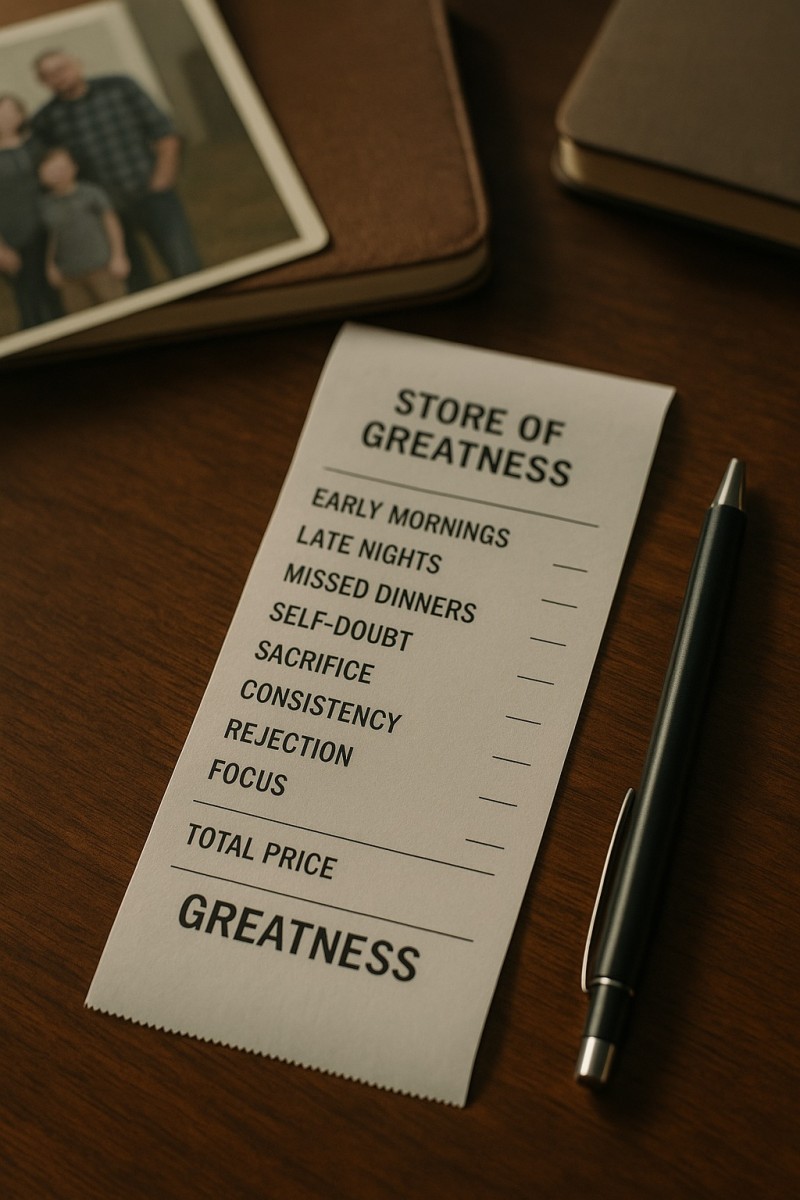
But I learned the price the hard way: through early alarms, missed dinners, sleepless nights, and bad knees.
Greatness always demands something of us. It’s like those old witches or trolls from fairy tales, the ones who made the prince or princess trade something they valued to get what they truly wanted.
These days, I want to be a great writer. So I read a lot. I talk to other writers. I get up early to write—which means going to bed early. I don’t watch much TV or Netflix. I’m constantly trading things in to get better at the craft. Sometimes it even feels like I’m trading my sanity for words on a page.
But I’m willing to pay the price.
I also want to be a great dad. That often means putting my own needs on the back burner, including my desire to be a great writer. Sometimes it means being the “mean parent” who enforces boundaries. Other times, it means sitting in the stands, even when my kids barely see the field. It means saying no to impressive opportunities that would pull me away from what matters most.
But I’m willing to pay the price.
Being great means showing up and putting in the work. Even when it’s inconvenient. Especially when it’s inconvenient.
I saw that mindset in many of the senior military leaders I served with. They didn’t just want to be good—they wanted to be great. And they paid for it.
They moved when the Army told them to move. They took the hard jobs others avoided. Their deployment stripes told stories of years overseas serving their country. They studied their craft. They bore the cost—and it showed.
General McChrystal captured all of this much more succinctly in On Character, when he wrote, “I am convinced that few truly great achievements are reached by individuals with an impressive work-life balance, and the price of greatness is, in a word, great.”
Now, in this new phase of life, I try to approach greatness differently. I start by asking a few questions before my eyes get big thinking about “being great”:
What will this cost me?
What will I trade away to be great at this?
And most importantly:
Why do I want to be great at it in the first place?
Because while the cost isn’t always clear up front, the why is what gives me the strength to keep showing up. The why is what makes the price worth paying.
Without a strong why, we’ll give up on greatness the moment it gets hard—and it always gets hard. Especially when the trade-offs aren’t easy. Especially when the price is great.
Joe Byerly is a retired U.S. Army Lieutenant Colonel with 20 years of service, including tours in Iraq and Afghanistan, and command of a cavalry squadron in Europe. He earned numerous prestigious awards, including multiple Legion of Merits, Bronze Stars, the Purple Heart, and General Douglas MacArthur Leadership Award. In 2013, Joe founded From the Green Notebook.
A passionate advocate for self-knowledge through reading and reflection, he authored The Leader’s 90-Day Notebook and co-authored My Green Notebook: “Know Thyself” Before Changing Jobs, a resource for leaders seeking greater self-awareness. If this post resonated with you or sparked any questions, feel free to reach out to him at Joe@fromthegreennotebook.com.