By Joe Byerly
Since 2017, I’ve been compiling an annual reading list of the books I’ve finished each year. As the year winds down, I take time to reflect on what I’ve learned. For me, reading isn’t about getting smarter—it’s about living better. Books have helped me gain a deeper understanding of the world around us and, more importantly, a clearer understanding of myself.
Thank you for taking the time to open these emails each month and for learning alongside me. Wishing you and your family a joyful holiday season and all the best in 2025!
Lesson 1: Staying the course is easy, quitting is hard.
If you’ve been following this newsletter or listening to the podcast, you’ll know that I retired a few months ago from the Army after a 20-year career. This transition, along with several of the books I’ve read this year, has driven home one of life’s hidden truths: staying the course often feels much easier than walking away.
But why is that?
Most of what we do in life becomes part of our identity, and identities are incredibly resilient. I was reminded of this while reading The Nolan Variations by Tom Shone, which explores the creative mind of Christopher Nolan. In Inception, Leonardo DiCaprio’s character Cobb asks, “What’s the most resilient parasite? Bacteria? A virus? An intestinal worm?” His answer: “An idea. Resilient. Highly contagious. Once an idea has taken hold of the brain it’s almost impossible to eradicate.”
Our identities function the same way—once they take hold, they’re almost impossible to release. Walking away is like prying loose a death grip on what feels safe. Think back to when we were kids learning to swim—how hard was it to let go of the edge of the pool? That same fear and hesitation follow us into adulthood, keeping us clinging to what’s familiar, even when it no longer serves us.
We do this with careers, habits, relationships, and even wars.
As William and Susan Bridges wrote in Transitions, “We have to let go of the old thing before we can pick up the new one—not just outwardly but inwardly, where we keep our connections to people and places that act as definitions of who we are.”
And maybe that’s the key. The things we struggle to quit aren’t just things—they’re extensions of who we are. As Annie Duke explains in Quit, “When your identity is what you do, then what you do becomes hard to quit, because it means quitting who you are.”
Letting go, then, isn’t just about change—it’s about redefining ourselves. And that’s never easy.
If the struggle to let go is rooted in the fact that what we need to release is part of our identity, then how the hell do we do it?
Lesson 2: We Need Quiet Time to Work Through Stuff -because it needs our attention.
We need to carve out time for quiet reflection. It’s the only way to deliberately process our thoughts and intentionally rewrite the internal scripts that keep us tethered to things deeply tied to our identity.
I keep returning to this message of quiet reflection because the need for it keeps resurfacing in my own life. It’s hard!! You and I are surrounded by noise and distractions.
Over time, the constant bombardment of noise starts to feel like normal life. As Joseph McCormack writes in Quiet Works, “Once you get used to the constant bombardment of noise, it just looks and feels like normal life…with the endless sources of information and constant connectivity, the reach of noise is seemingly endless from morning to night, wherever we go.”
The problem is, when we’re distracted by the noise, we can’t focus on what’s going on inside us. Instead, we drift through life in default mode.
Chase Jarvis highlights this in his book Never Play It Safe: “When it comes to living a life by design rather than default, we have to step out of the technological fray in order to carve our way through the algorithmic land mines, face ourselves, and figure out what we really want.”
This is where taking control of our attention matters. When we’re deliberate with our attention, we can drown out the noise and think—think deeply. Dr. Amishi Jha explains in Peak Mind, “Attention simultaneously highlights what’s important and dims distractions so we can think deeply, problem-solve, plan, prioritize, and innovate.”
For me, quiet reflection has become a daily ritual, and carving out this time has made all the difference.
I use the word ritual instead of habit because rituals bring something deeper to our lives. As Dr. Michael Norton writes in The Ritual Effect, “Good habits automate us, helping us get things done. Rituals animate us, enhancing and enchanting our lives with something more.”
For instance, my morning ritual of drinking Alpha coffee, reading, writing, and reflecting has helped me navigate this transition much better than if I had continued running at 100 mph.
By focusing my attention, and quieting the world around me, I was able to focus on the present instead of being stuck in the past –which is an important step in letting go.
Lesson 3: Make the Past, “Past Tense”.
When Jack Carr retired from the Navy in 2016, he left that career behind to embark on a new and equally daunting journey: becoming a thriller writer. In the past eight years, he’s written eight bestselling books, three of which have reached number one on the New York Times bestseller list. In the opening pages of his first novel, he wrote, “Serving my country as a Navy SEAL was something I did. Past tense. I’ve turned in my M4 and sniper rifle for a laptop and a library as I fulfill my lifelong dream of writing novels.”
Many of the authors I read this year have done something similar. Terry Hayes left Hollywood behind to become a novelist. Chase Jarvis dropped out of college and rose to prominence as one of the world’s top industrial photographers. Ryan Holiday left a marketing career to become a modern-day philosopher, selling over five million books to date.
I’ve also spoken with former Army leaders who are now high school coaches, executives, and entrepreneurs, teachers who are now salespeople, and stay-at-home moms who are now teachers.
Our identities are never fixed. As Steven Pressfield reminds us in The War of Art, “Never forget: This very moment, we can change our lives. There never was a moment, and never will be, when we are without the power to alter our destiny.”
When we let go of an identity we’ve held onto, we must truly leave it in the past and move forward. We have to make the past, past tense.
Thank you all for following my reading journey in 2024. I wish you and your families nothing but the best as we head into 2025.
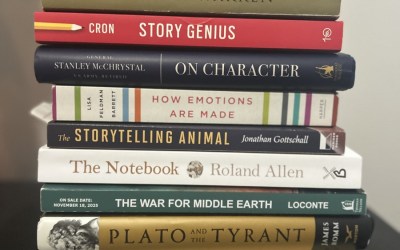
Below is a list of my monthly emails and the books I highlighted in each newsletter. Each book has shaped the person I am as I close out another year, and I hope you find something meaningful in this list, just as I have.
Joe Byerly is the founder and director of From the Green Notebook and host of the podcast. He officially retired from the U.S. Army on August 31, 2024. If this post resonated with you or sparked any questions, feel free to reach out to him at Joe@fromthegreennotebook.com.