by Reed Markham
Have you ever felt that the more you teach your Soldiers with words the less they get it? Or even listen? I have witnessed brilliant and experienced leaders struggle to train their teams over the years, and wrestled with the same. It is hard to raise the entire group’s performance instead of just the talented and hardworking, without devoting excessive time, ammo, and energy, to the problem. My concern about this challenge grew as our unit approached its major training event – platoon live fires.
However, there was a time in the past when I experienced something different. During company command, my brigade commander (and Army Legend) COL (ret.) Michael Getchel, ‘The Getch’, led our first Company Live Fire as the Company Commander. COL Getchel made his platoon leaders the Battalion Commanders, his Company Commanders the Squad Leaders, and his Senior Enlisted Advisors filled in the remainder of the ranks. He called it a “Leader Live Fire.” Perhaps The Getch either heard or instinctively knew GEN Colin Powell’s sage advice, “the most important thing I learned is that Soldiers watch what their leaders do. You can give them classes and lecture them forever, but it is your personal example they will follow.” This is how The Getch taught us to train our people. Leader Live Fires certify leaders, build cohesive teams, and exercise the mechanics of the range, all while being a blast.
—
First, a quick description of a leader live fire. Typically, the leader designated as the primary trainer (i.e. the brigade commander for company live fires, the battalion commander for platoon live fires, or the company commander for squad live fires) will execute the training as the training audience’s leader before transitioning to their original role as lead evaluator.
Though there are no rigid parameters, leader live fires can also employ the certifier’s team as members in the smaller unit. In my battalion’s platoon live fires, we built a platoon where I served as the platoon leader, my command sergeant major the platoon sergeant, our company commanders as squad leaders, and finally platoon leaders and sergeants as team leaders, automatic rifleman, and rifleman. Our battalion fire support officer was our platoon’s forward observer, and our signal officer was the radio telephone operator. The battalion executive officer was our senior safety, and our brigade commander certified the live fire as our lead trainer. This allowed him to provide our leaders his guidance and intent for our training. There are endless variations to the model because any leader-level can execute as a subordinate leader; for example, a company commander can act as the platoon leader while his subordinate leaders fill out the platoon.
The proven and reliable 8 step training model has rightly become the Army profession’s “north star” for planning and executing training. Lately, I have heard additive guidance from some of our Army’s best trainers that weighing the efforts of the first three steps—1. plan the training, 2. train and certify leaders, 3. recon the training site—increases training efficacy. And of those three, step 2 has the highest return on investment.
The leader live fire is the perfect vehicle for units to laser-focus on training and certifying leaders. Leader live fires give platoon leaders the opportunity to watch a seasoned leader brief their platoon, execute inspections and rehearsals, and then lead them through the operation. This gives subordinate leaders a tangible model to follow. In the planning and preparation phase, subordinate leaders learn through observing and participating in how to highlight key aspects of the terrain and enemy, simple ways to communicate the scheme of maneuver, what to personally inspect, and how to quickly, but effectively, rehearse. In a way that is impossible in the classroom, lessons come alive for junior leaders during a leader live fire as they see the features of leader placement, effective primary, alternate, contingency, and emergency (PACE) communication plans, and leaders’ reconnaissance put into action. Junior leaders learn through practice to synchronize their internal and external assets and mass on the enemy.
The value in leader live fires is not focused solely on new lieutenants. I found that leader live fires prepared me to train and evaluate others after I personally executed the training. Having the stimulus of not wanting to look incompetent in front of your battalion’s fellow leaders helps prioritize brushing up on platoon-level planning and the right training evaluation and outlines (TE&Os). The same effects trickle down through both officer and non-commissioned officer ranks as they execute the training themselves, then in turn go back to prepare their subordinates. There is always risk when we put ourselves out there in front of our Soldiers, but also opportunity to build trust through displays of competence.
Just as important as training warfighting skills, leader live fires build cohesive teams through shared hardships and successes. Tough physical fitness and field training brings a team together, challenges them to overcome a tactical problem, and then rewards success with a sense of comradery and cohesion. Leaders can adjust the degree of hardship and challenge to the time available and needs of the unit by changing the length of movements, the number of objectives, and the type of terrain.
Fun is also a factor that can–and should!—count when doing live fire training. Shooting weapons, firing mortars, breaching obstacles, throwing hand grenades, and assaulting across an objective is a great time – and what most of our Soldiers had in mind when they joined the Army! Getting our leaders out of the office, back in their kits, and reliving their glory days in face paint is a terrific way to create lifelong memories. Our team still jokes about how one of our more swaggering platoon sergeants made it very clear he was going to carry the squad automatic weapon and then put on a show as he expertly ripped rounds into the hapless enemy targets. At the risk of embarrassing myself, there was also a funny memory made when a senior leader whiffed his first throw of the flaming rock to shift the support by fire – which was then quickly, and athletically, rectified!
Leader live fires create value in several other ways as well. The unit can save precious preparation time by using the event as a final full-dress rehearsal of safety and logistical systems. The same leaders who keep their units on-time during training get a rep at the range flow, better equipping leaders to facilitate ammo draw, staging, conducting the after-action review (AAR), and lane reset for each iteration. Leader live fires can also replace the tactical exercise without troops (TEWT) if executed in a way that allows leaders to understand the key safety[i] aspects of the range.
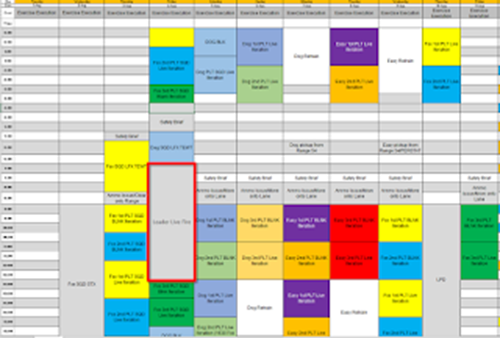
Leaders throughout our Army lead by example. Leaders overseeing live fires have most likely executed the duties of the leader they are training. My recommendation to implement leader live fires in your unit will not add just another activity to your schedule, but rather will bundle the way you train warfighting and build cohesive teams into one fun and effective event. Using only the existing mechanics of the range and your team’s skills, leader live fires are a practical method to accomplish the objectives of live fire training, boost morale and comradery, and preserve time.
LTC Reed Markham is an active-duty Army officer, has served since 2005, and led and trained Soldiers from the platoon through battalion-level. LTC Markham is currently in command of 2-506th IN, 3/101 Airborne (Air Assault) at Fort Campbell, KY. The article was edited, and made possible, by the author’s wife, Allison Markham.